Hormuz in North Africa: The War for the Operators
Severe crises do not merely pass through economies. They rewrite their rules.
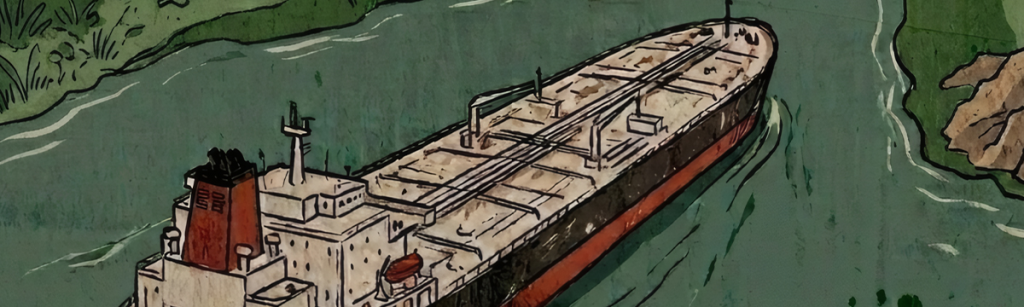
On 28th February 2026, the Strait of Hormuz closed. Three and a half months later, on 17th June, Iran and the United States signed a memorandum of understanding aimed at reopening it. In the intervening period, the strait’s status veered between total closure and a porous blockade. The architecture of trade is being reshaped.
What is striking about this episode is not the violence of the initial shock, but the remarkably uneven manner in which its effects have been felt. Comparable countries, exposed to the same trade flows, have followed diverging trajectories. How can one shock yield such disparate outcomes?
Three questions arose at once. Who can still go there? At what cost? Who can do without it? This analysis begins with these. It offers a conceptual framework. The Hormuz crisis serves as its empirical point of departure. The usual responses address these questions piecemeal. Passage restrictions are read as geopolitical shocks. Price variations, as market adjustments. The erosion of buffers, as a coordination or resilience problem. Yet their juxtaposition reveals a blind spot. The piecemeal approach describes mechanisms without accounting for the common logic that links them. The Hormuz crisis makes this logic particularly salient. This analysis does not purport to describe a universal law. Realities are always more complex than any model. But it provides a vocabulary for describing what fragmented approaches fail to capture.
The initial shock: a multisectoral materialisation
The closure of Hormuz took between 10 and 20 million barrels per day off the market. Up to a quarter of global oil trade. One‑fifth of LNG (IEA). Bypass capacities and strategic reserves absorbed only a fraction of the shock. The rest diffused through price corrections on chemical and metallic feedstocks. Their logistics had compressed around a low‑latency corridor. Naphtha surged 78% (Yonhap Infomax) (TraderKnows). Sulphur, 119% (S&P Global). Ammonia, 36%. Helium doubled after the partial shutdown at Ras Laffan (Financial News). Sulphuric acid, which is indispensable for leaching, climbed to as much as 1,000% on the tightest market segments in China (Firstpost).
These price‑signal distortions filtered down into production chains. Eurozone manufacturing PMIs are contracting. Worsening in May (S&P Global). Energy costs have raised agricultural input prices. The FAO notes a tightening of the food‑system stabilisation window (FAO). Higher costs are widening fiscal deficits. The 30‑year US Treasury yield has breached 5%. Its highest since 2007 (Goldman Sachs).
These price movements are not the real issue. Iran’s strategy has not merely blocked a strait. It has demonstrated that it can turn it into a weapon. A weapon that remains loaded. Placed conspicuously on the negotiating table. The crisis is now latent. The current equilibrium, fragile. That fragility is a lever for Tehran. But to what end was this weapon loaded? To control what, exactly?
Hormuz : but what is a strait ?
To grasp the stakes, we should take a step back. Several steps. What is a strait? A point. No. Two points. One at the entrance. One at the exit. More fundamental still: these two points can be connected. A possible path exists. Add water between the rocks and the points. An architecture emerges. Hormuz. The path is no longer merely possible. It becomes available.
These two points are not equivalent. Add other points to the map. The strait’s entrance connects to the Gulf’s oil fields. Its exit connects to the world’s major shipping lanes. As connections emerge, the points cease to be mere positions. They become hubs. Places where several available paths converge and diverge.
We have a strait. But it does not yet have any stakes. Let us introduce a resource. A barrel of oil. Like those exported by Gulf producers. Now place two barrels inside the strait. The first sits on a hub connected to the exit by a single path. From that position, it has only one option. Cross the waters of Hormuz. The second is placed on another hub. This one connects to the strait, but also to a pipeline. Two paths allow it to reach the exit. Cross the strait. Or take the pipeline.
The two barrels are identical. Only their position differs. Yet their possibilities are no longer the same. The second has more paths to its destination. Its “reachability” is greater. Its room for manoeuvre increases. Its passage also becomes harder to contest. Even if one route closes, the other remains open.
Let us retain only our first barrel for what follows. Everything is still static. Inert. Do we actually see the barrel move? No. We never see its continuous movement. We only observe a succession of positions. Here. There. Over there. Actualised positions. Between these positions, an infinity of others exist. We do not see them. But from the succession of actualisations, an order emerges. A series of ordered snapshots. Temporality.
This temporality allows us to define events. What is an event? A transformation of the system’s configuration. Sometimes this transformation alters the available paths. A war. The bombing of a pipeline. The opening of a new corridor. The architecture is thereby reshaped. But an event does not always require a crisis. A barrel simply crosses the strait. Its passage leaves a trace on the system’s configuration. It may, for instance, ease the route for the next barrel. This passage is an event.
And here we are. Only three objects. An architecture. A resource. A displacement. Three questions arise. Three questions tied to the three moments of the displacement. Before, what paths exist? During, what impedes it? After, what room for manoeuvre remains?
These three questions are not abstract enquiries. They designate three measurable properties of the system. Access. Friction. Elasticity. Three operators. Three levers that the crisis has brought to light and which the remainder of this analysis examines one by one.
Constraint operators: the spoils of war
Before the crisis, these three questions already existed. They were diffuse. Access was taken for granted. Friction was reflected in prices. The system’s elasticity was not put to the test. The strait’s closure concentrated risk. The three questions became visible. Acute. Palpable. And immediately contested.
The access operator is discrete. Often binary. The path is available. Or it is not. The operator counts the number of available paths enabling a resource to reach its objective. Yet behind this measure lies a struggle for control over those paths. The United States and Iran lay rival claims to authority over the strait. Each seeks to define access. Contestation never disappears. At times, an acute phase. Military. Blockades. Open combat. At times, a latent phase. Order becomes bureaucratic. Relatively stable. Until it cracks. At present, this equilibrium has not yet been reached. On one side, the Persian Gulf Strait Authority (New York Post). On the other, Western sanctions upstream (OFAC), private litigation (Lexology) and asset seizures downstream (Fox Business). Mutually exclusive obligations. Observables include the creation of transit authorities, changes to sanctions regimes and vessel queues.
The friction operator is continuous. It measures a cost. It aggregates effort, time and risk. This measure reveals another form of contestation. Also constant. Assert who controls price effects. Make passage cheaper for allies. Costlier for rivals. During acute phases, prices spike. War risk insurance premiums reached 3% of hull value, up from 0.25% before the conflict (Reuters). During latent phases, order becomes tariff‑based. Volatility subsides. Prices stabilise. The cost of passage, predictable. Today, this stabilisation remains incomplete. Iran is exploring domestic insurance mechanisms to reduce its dependence on a Western monopoly (Al Jazeera). Observables include insurance premiums, sovereign bond yields and spot-futures spreads.
The elasticity operator is systemic. It measures a capacity. The system’s capacity to absorb a shock and redistribute the load. This capacity is not fixed. It emerges. From route redundancy. From supply diversity. From available buffers. This capacity also becomes an object of contestation. Establish who guarantees the system’s stability. During acute phases, the system becomes disjointed. Each state pursues its immediate interest. Without coordination. On 1st May, the United Arab Emirates leaves OPEC. US strategic reserves fall to their lowest level since 1983. Absorption ceases. Local responses become faster but less coherent. It gains in sensitivity. It loses in stability. During latent phases, order is reshaped. New redundancies are established. New buffers. This equilibrium also remains incomplete. Observables include reserve levels, participation rates in coordination mechanisms and new oil and gas pipelines.
These three operators are not independent. Modifying one can reconfigure the other two. Bureaucratic deadlock increases insurer caution. Insurer withdrawal tightens access requirements. Depletion of buffers amplifies fluctuations. Thus, some insurers condition coverage on routings approved by Iranian institutions. At present, acute and latent phases alternate. An integrated order has yet to stabilise.
Military crisis over? Do the operators remain relevant?
Asymmetry and hysteresis: the scars left by events
The strait, as a system, does not merely aggregate events. By stacking them in ordered fashion, it creates its own past. A diplomatic resolution does not restore the previous equilibrium. The buffers that absorbed the shock constitute only an intertemporal transfer of constraint. A transit authority, once created, does not mechanically disappear with a ceasefire. The compression of insurance premiums requires a long period of sustained peace (The Guardian). A fractured cartel cannot be repaired with a simple decree. New oil and gas pipelines are being announced.
Hysteresis, the property of a system by which it retains the trace of shocks, is not an absolute irreversibility. It is a structural asymmetry born of actualisations. They define a before and an after. Not all actualisations produce hysteresis. If an event can be perfectly undone, it leaves no lasting trace in the system’s configuration. Not all actualisations produce hysteresis at all scales.
Regarding Hormuz, the crisis has already modified expectations in a durable way. The US authorities themselves concluded in June that Iran can now close the strait “at will” (CNN). The pre‑war configuration is no longer the system’s natural attractor. It is an inaccessible historical state. Deliberate reconstruction carries a prohibitive cost in time and effort. It cannot be instantaneous.
In the current configuration, the latent economic crisis can remain silent. Smoulder without erupting. As today. The crisis can also break abruptly. The system has consumed its buffers. A hurricane in the Gulf of Mexico. An intense El Niño episode. The spring is coiled. The Iranian weapon, loaded.
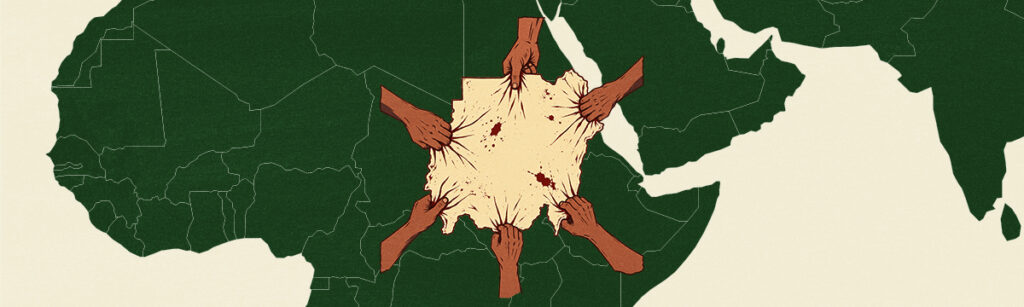
In North Africa, six economies are being measured.
Exposure: North Africa in the constraint matrix
The objective is not to predict. We will put the operators to the test. Measure each economy’s position in the new architecture of constraints. Analyse the vulnerabilities that the crisis brings to light. The Hormuz crisis reshapes states’ room for manoeuvre. Each strategic flow is a resource. Its reachability is reconfigured. At this scale, states themselves are resources. They vie to secure these flows.
Tunisia: budgetary patient zero
Tunisia’s 2026 budget is built on oil at 63.3 USD per barrel (Tustex). Public debt stands at 82.1% (Tunisian Ministry of Finance). Foreign exchange reserves cover 103 days of imports. Tunisia’s objective: finance its budget without compromising its sovereignty.
The access operator counts available paths for energy imports. Geography narrows the options. Tunisia does not lack potential suppliers. It lacks available and credible alternative routes. Infrastructure. Existing contracts. Transport costs. Access is concentrated on a very limited number of options. Libya remains unstable. Algeria emerges as the dominant supplier. Any alternative would be considerably more costly. The infrastructure between the two countries is already amortised. Tunisia even receives a transit fee for Algerian exports transiting to Europe.
The Hormuz crisis does not create this dependence. It deepens its strategic significance.
The friction operator assesses the cost of connectivity. For Tunisia, that cost is first felt in the price of imported crude. Algerian crude is indexed to international markets. The crisis has made those markets more volatile. Every additional dollar bites into the balance of payments. Volatility intrudes on a budget that had not accounted for it. It translates into a sovereign risk premium. Tunisia, already heavily indebted, finds its refinancing conditions tightening. It must secure external capital. Loans. Aid. Every package comes with conditions. Fiscal sovereignty shrinks as friction rises. Friction does not merely raise the cost of energy. It also raises the cost of every decision taken to access it.
The elasticity operator measures absorption capacity. It also measures the capacity to preserve available paths in spite of the shock. That capacity is weakening. OPEC no longer smooths prices as effectively. Gulf allies no longer compensate for volatility to the same degree. The budget is more exposed to raw price volatility. Every extra dollar that isn’t absorbed exacerbates the solvency risk. Reduced budget margins. Limited substitution capacities. The system retains paths. Costlier. More fragile.
Through the lens of the three operators, Tunisia’s stranglehold appears more financial and geopolitical than volumetric. It enters the crisis without leverage. No cushion of its own. It is fully exposed to global conditions. A dilemma emerges. How to manage risk? Secure a privileged energy relationship with a larger neighbour? Or preserve fiscal margins through financing from outside the region? Energy dependency or financial dependency?
Morocco and Egypt: systemic mass as the differentiating factor
Both countries have comparable importer profiles. They should experience the crisis in similar ways. They do not.
The difference lies neither in import volumes nor in trade structure. It lies in a property that the operators reveal. Systemic mass.
Mass is not a metaphor. It is a relational property. It measures how many other resources have their possibilities reconfigured when a given resource changes position. A structural centrality. It depends on the number of paths passing through the resource. Through its territory. Its market. Its infrastructure. Every additional path that depends on it increases its mass. This property appears neither in debt ratios nor in trade balances. It appears in how the operators are deformed.
The access operator crystallises a single point of failure for Morocco. OCP Group is structurally dependent on sulphur imported from the Gulf. The supply disruption reduced its production by around 30% as early as spring (Reuters). Revenues collapse. Costs soar. The trade deficit widened by 18.4% in four months. For Egypt, access does not disappear. It fragments. The Suez Canal’s position places the country at the crossroads of a multitude of trade flows. When Hormuz becomes uncertain, some routes are interrupted. Others are rerouted. Still others remain open. Risk is spread across multiple paths. Access never falls to zero. Rather, predictability degrades. Constraint then becomes structural noise rather than blockage.
The friction operator raises the energy bill for both economies, but along two distinct trajectories. In Morocco, with energy dependency close to 94% of imports (World Bank / IEA), the effect is linear. Immediate. In Egypt, dependency is more moderate, around 20% in 2023 (World Bank / IEA). The shock is less severe. The constraint shifts. It affects the structure of flows more than their volume.
The elasticity operator lays this asymmetry bare. Morocco’s strategic reserves are estimated at between 38 and 52 days (LesEco.ma). Internal elasticity is low. Egypt externalises part of its own. Its domestic gas fields absorb part of the shock. Its regional position and the Suez Canal strengthen its capacity to mobilise external support. In times of stress, mass functions as an implicit triage criterion. Egypt survives less through internal resilience than through weight.
Under the same system of operators, two contrasting constraint topologies emerge. Concentrated vulnerability versus distributed exposure. Mass is a property that the crisis uncovers. It gives Egypt greater room for manoeuvre.
Sudan and Libya: fragmented winners
Sudan and Libya present counterintuitive results. Thanks to their resource endowments, they should benefit from a commodities price shock. They do not. The reason lies in a property of their internal architecture. Fragmentation. It measures the difficulty of moving within a hub itself. In other words, the internal distance between its own components. At the geoeconomic scale, these countries are resources. At the national scale, architectures. Resources struggle to move within their territories. The paths are fragmented. The effects of the crisis are dissipated by this fragmentation.
For example. Libya. Building a domestic pipeline has different effects at different scales. It alters the internal architecture of the hub. At the national level, fragmentation shrinks. Oil moves more freely between production zones and terminals. At the supranational level, Libya’s standing in the geo-economic space also shifts. It goes from “no pipeline” to “pipeline”. The same piece of infrastructure thus reconfigures two architectures at once. One internal. The other regional.
The access operator only affects these economies indirectly. They do not rely on Hormuz for their exports. But Sudan’s war economy depends in part on Gulf financing and imports. Hormuz disrupts these flows. Their fluctuations ripple through the country’s internal balance of power. They affect, among other things, the supply and funding networks of the Rapid Support Forces (Horn Review). A shock to the strait alters the balance of power in a civil war. A second-order effect.
The friction operator sends a bullish signal. Elsewhere, that signal would boost exports. Here, it hits fragmented export chains. Physically in Sudan. Destroyed infrastructure. Fragmented production zones. Institutionally in Libya. Rivalries between competing authorities. No unified contractual framework. The price signal is positive. But there are no mechanisms to convert it into revenue. Fragmentation neutralises friction.
The elasticity operator exposes the absence of stabilisation mechanisms. No sovereign fund. No macroeconomic smoothing capacity. A positive shock cannot be converted into a sustained trajectory. The price signal finds no structure to translate it into investment capacity. Room for manoeuvre does not increase. Potential gains remain uncaptured. Unconverted.
These economies possess strategic resources without the architecture required to improve their strategic standing. The operators do not only reveal constraints. They expose the absence of conversion mechanisms between endowment and position. Sudan and Libya illustrate the neutralisation of comparative advantages through internal fragmentation.
Algeria : structural distance
The previous economies have illustrated four configurations: transmission, convergent interaction, negotiation through systemic mass and neutralisation through fragmentation. The Algerian case reveals a fifth.
So far, the operators have been presented as simple measurements. But these measurements have addresses. The access operator is read in the strait itself, in the courts, in sanctions. The friction operator is embedded in the financial and physical markets of London, New York or Geneva. The elasticity operator is spread across Washington, Brussels, Vienna and the Gulf capitals. The distance separating an economy from these observables determines the intensity of the transformation it undergoes. Structural distance is defined as a country’s remoteness from the nodes where the operators are legible. It depends on the routing of flows, financial integration and institutional dependence. The greater this distance, the weaker the transmission. High structural distance dampens the operators’ effects. Algeria offers a strikingly readable case.
The access operator links exposure to transit dependency on Hormuz. Algerian gas is transported mainly via pipelines. It does not face either the Persian Gulf Strait Authority or the double bind of sanctions. Exposure is indirect. Paralysis in the strait removes Gulf competitors from the market. It increases demand for Algerian gas (Arab News). The shock becomes pressure on production capacity.
The friction operator has a limited but more pronounced effect. Exports use less risky Mediterranean routes. Residual exposure is indirect. The risk premium on Gulf crude feeds through to the benchmark price against which Algerian oil is indexed. A muted transmission. Largely positive.
The elasticity operator could have the most measurable impact. Algeria relies neither on OPEC quotas nor on external strategic reserves. Residual exposure materialises through fiscal volatility. The Revenue Regulation Fund cushions part of it.
Structural distance shapes how acutely local consequences play out. Some doors close. Others open. A short distance puts a resource closer to the nodes where the operators are legible. The US‑Iran competition is a fight for control over those hubs. A long distance can offer more room for manoeuvre. Provided the economy is not cut off from essential flows. A zone of loose coupling where lack of integration can become an opportunity. A conditional possibility. Not predestination.
Sahelocracy, power through the shore[1], can be read as the strategic expression of this position. A configuration of structural distance paired with an attraction strategy that straddles maritime and terrestrial interfaces. An alternative to contested straits. Not a rule taker. A rule maker[2].
Conclusion: a grammar to navigate the constraint matrix
The breakdown of the Hormuz crisis lays bare an analytical challenge. Economies subjected to the same shock face different constraints and retain different degrees of freedom. Classical explanations account for these differences through a multitude of mechanisms but rarely do so within a shared analytical framework.
This study proposes a common language. It rests on three measurements. The constraint operators. Access. Friction. Elasticity. They describe three complementary dimensions that define freedom of action. The aim is not to replace existing approaches. It is to provide a grid capable of articulating them within a single analytical framework.
Applying this framework to North African economies reveals properties that do not show up in standard macroeconomic indicators. Systemic mass measures the extent to which a resource can reconfigure its environment. Internal fragmentation measures the difficulty of converting an endowment into effective capacity for action. Structural distance captures how constraints are transmitted relative to a country’s position in the geoeconomic space. These properties do not replace conventional economic variables or institutional factors. They add a further layer of analysis. They help explain why comparable economies respond differently to the same shock.
Nothing in this approach is unique to the Strait of Hormuz. The framework is not built to explain a single crisis, but to analyse situations in which essential flows have their reachability reconfigured. Whether supply chains, financial networks, migration systems or, more broadly, any system organised around resources and flows, the same questions remain. Which paths are available? At what cost? And with what capacity?
The framework presented here does not claim to be a general theory. It offers a lens that could now be applied to other crises and other contexts, and, where appropriate, be subjected to more rigorous formalisation. Its future remains open to more distant horizons.
[1] From the Arabic sāḥil, meaning coast or shore, and the Greek kratos, meaning power.
[2] The concept of Sahelocracy was first proposed in two earlier pieces:
– Twala, La Partie d’Ormuz ou le réveil de la Sahelocratie, 4 May 2026, https://twala.info/en/opinions-en/the-game-of-hormuz-or-the-awakening-of-the-sahelocracy
– Middle East Eye, How the Strait of Hormuz crisis is reshaping the old world order, 7 June 2026, https://www.middleeasteye.net/opinion/how-strait-of-hormuz-reshaping-world-order
This article provides its first analytical articulation and embeds it within an explicit theoretical framework.