Has the Khartoum Era Come to an End?
The Impact of War on the Dynamics of Influence in Sudan
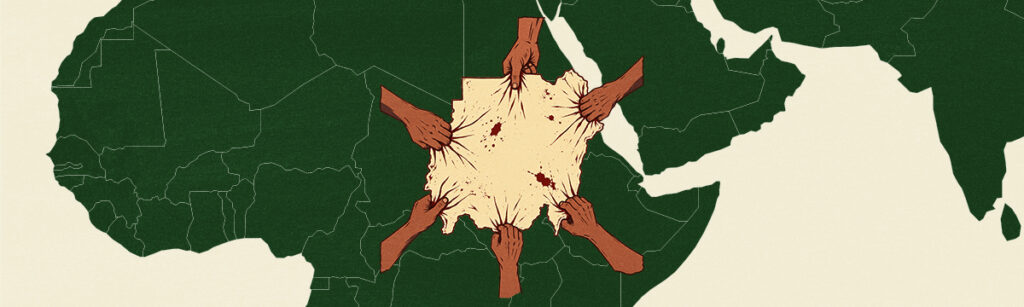
Nearly a year has passed since the Sudanese Armed Forces (SAF) regained control of the country’s capital, Khartoum, yet the city remains haunted by pressing questions regarding its future as Sudan’s capital and central state. Indeed, the war has upended the city and shattered the myth of the “dominant center” that monopolized political and economic power for decades.
The capital, which was formerly a political, economic, and social dominant center, now appears to have lost its influence, decimated by widespread destruction and the mass displacement of its population. Khartoum has been reduced to a peripheral region where local authorities struggle to provide basic public services and support to the remaining few thousand residents.
In the midst of the authorities’ unrelenting yet ultimately futile endeavors to restore normalcy, Khartoum’s predicament transcends the authorities’ attempts to address the war’s aftermath and revitalize the once bustling life of a city rendered “clinically dead.” The current situation in Khartoum is far more intricate than meets the eye; once a dominant center, its influence has been thoroughly eroded in favor of numerous nascent centers of power established in various Sudanese cities during the war. Sudan is thus facing a new political reality in which the historically powerful tri-capital has lost its dominance.
The massive wave of forced displacement from Khartoum to more secure regions has profoundly altered Sudan’s development dynamics, engendering a striking transformation in the said regions both in terms of basic public services, formerly concentrated exclusively in Khartoum, and in terms of commercial and industrial activities, which have now been relocated to new cities.
In the days following the outbreak of hostilities in Khartoum, the city of Wad Madani (the capital of the central Sudanese Gezira state) was poised to serve as the country’s de facto interim capital, owing to its proximity to Khartoum. Nearly all of the displaced persons from Khartoum sought refuge in the city, leading to the partial relocation of government and commercial activities there. However, Wad Madani’s respite was brief, as fighting swiftly spread to the city. The Rapid Support Forces (RSF) advanced into Gezira State, encountering a similar fate to Khartoum, which was subsequently recaptured by the Sudanese Armed Forces (SAF).
Concurrent with the displacement from Khartoum to Gezira State in the early stages of the war, the River Nile State, situated to the north of Khartoum, came to the fore as a safe haven and an ideal refuge for tens of thousands of displaced persons, thereby attracting commercial and industrial activities to the region. These developments culminated in a substantial enhancement of basic public services. Since the northern regions were largely spared from the war, they experienced significant stability and the establishment of services. This caused some cities in these regions to gradually turn into centers of power that replaced Khartoum.
Khartoum: A Long History of Centralization
Since the country’s independence in 1956, Khartoum, the capital of Sudan, has remained the political, economic, administrative, and social center of the nation. Its geographical location at the approximate center of the country’s vast territory has bolstered this status.
Nevertheless, Khartoum is regarded as a “colonial legacy,” as the Sudanese state was inherently flawed from its establishment; Khartoum exemplifies the preeminence of an opulent elite over a considerably diverse social fabric. Bequeathed by colonizers, this elite ruled Sudan with the same colonial methods, monopolizing all privileges at the expense of the remainder of the population. This perpetuated an “internal colonization” that entrenched an uneven development in favor of the Middle Nile region and to the detriment of the marginalized periphery. The legitimacy of armed militant movements as a form of resistance against an elite that had amassed wealth and left only crumbs for the periphery was later legitimized by this blatant monopoly on resources and decision-making.
From the country’s woodlands of the south to the arid lands of Darfur, militant narratives coalesced around the objective of “deconstructing the dominant center.” The Sudan People’s Liberation Movement (SPLM) waged a 20-year struggle in South Sudan that culminated in the 2005 Comprehensive Peace Agreement (CPA). This agreement included the right to self-determination, which led to the proclamation of an independent South Sudan in 2011.
Before the war in the south ended, militant movements in the Darfur region took up arms against the central government, demanding a redistribution of power and wealth. The Darfur movements were consistent in their adherence to the very principles upon which the Sudan People’s Liberation Movement was founded, albeit with slight variations. All the liberation movements in the country’s periphery shared a unified theoretical framework rejecting the dominant center’s stranglehold on power and wealth while relegating the periphery to subordinate status. The periphery was left begging for basic services and was subject to the dominant center’s high-handed distribution of power and resources.
Uneven Development: From the economic realm to the battlefields
Khartoum held all political, economic, and service privileges, which disadvantaged the rest of Sudan’s regions. Consequently, from the vantage point of the marginalized periphery, Khartoum metamorphosed from a mere national capital to a “symbol of exclusion,” thereby rendering the April 2023 uprising an unavoidable consequence of the amassed class and ethnic resentments.
Although Sudan has experienced civil wars in the past, the April 2023 war is markedly distinct from the previous conflicts that have beset the country. This war broke out in the heart of the country, bringing all sectors to a complete halt. Thus, the conflict is an ultimatum to the elite, urging them to take responsibility and unite to establish a state governed by the rule of law and principles of civic equality. The stark class disparities and social inequality underlying successive civil wars cannot be attributed to the policies of any particular government. Rather, they are the result of the state’s structural and systemic failures and mismanagement of economic development and resource distribution.
The practice of extreme centralization reached its peak under Omar al-Bashir’s regime, which turned Khartoum into a “black hole” that siphoned off the state’s resources to fund his dominant center. The systematic impoverishment of the periphery led to explosive demographic growth in the capital, where marginalized and displaced individuals created a “ticking time bomb.” The April 2023 war in Sudan is not merely a conflict among generals. Rather, it marked the moment when the policy of “militarizing the periphery” backfired, directly targeting a long-perceived unassailable political stronghold.
Thus, Khartoum’s centralized power was consolidated at the expense of the peiphery. However, this centralized power reached its zenith during the rule of Omar al-Bashir (1989 – 2019), a period that transformed Khartoum into a black hole siphoning off states’ resources in order to finance the latter’s political survival. Throughout al-Bashir’s rule, systematic underdevelopment and pauperization were inflicted on Sudanese cities, while nearly all services funded by these states’ resources were hoarded by Khartoum. Consequently, healthcare and education services across Sudan’s cities suffered a precipitous decline, with some cities witnessing a complete dissolution of these services. Unemployment and stagnant production in the states worsened as well, accelerating large-scale rural-urban migration toward the capital. The pre-war population of Khartoum State was approximately 15 million, as indicated by statistics and population growth indicators.
Several studies indicate that the first period of migration to Khartoum occurred between 1960 and 1980, during which people moved from the northern and central regions to the capital. The second period of migration took place between 1980 and 2000, propelled by recurring droughts and armed conflicts.
The systematic impoverishment of the periphery led to explosive demographic growth in the capital, where marginalized and displaced individuals created a “ticking time bomb.” Thus, the April 2023 war in Sudan is not merely a conflict among generals. Rather, it marked the moment when the policy of “militarizing the periphery” backfired, directly targeting a long-perceived unassailable political stronghold.
Successive central governments have pursued this policy, exposing Khartoum to constant criticism from all armed militant movements that champion the causes of the people of the periphery. The marginalized peripheral populations viewed Khartoum not just as a haughty capital, rather a “political adversary” that personified the sins of the state. Moreover, in a stark historical paradox, the al-Bashir regime resorted to safeguarding its central authority by “militarizing the very periphery”. This enabled the formation of pro-government tribal militias, which were tasked with quelling militant movements. Ultimately, however, the stronghold of Khartoum succumbed, and war erupted within the capital itself after matters reached a critical juncture.
Consequently, the issue of the uneven development between Khartoum and the periphery has evolved from a socio-economic concern to a political issue with ethnic undertones. Militant liberation movements have emerged along ethnically defined lines as a natural response to the predominance of a specific ethnic elite over the governance of the country. Within the political lexicon of Sudan, this ethnic elite is designated as the “Middle Nile,” an appellation that alludes to the populations residing in the central and northern regions of Sudan along the banks of the Nile.
This geo-ethnic designation became a political accusation leveled against the center. In response, militant liberation movements rallied behind their ethnic identities as a defense mechanism and as a natural response to the center’s control over power. The conflict has essentially devolved into a confrontation between an “exclusionary center” accused of ethnic supremacy and an insurgent periphery seeking recognition outside the traditional Khartoum establishment.
The proliferation of armed militant movements has not been confined to West Sudan. East Sudan, a region mired in underdevelopment and a dearth of public services, has also been grappling with this turmoil. Several insurgent groups took up arms against the central government and engaged in armed conflict that persisted until 2006, when the East Sudan Peace Agreement (ESPA) was signed, officially bringing to an end a nearly 13-year war. However, the situation in the region remained one of “fragile peace.” The root causes of the region’s chronic underdevelopment remained unresolved. The ESPA is similar to other peace agreements in Sudan’s history because it rehashed past mistakes. It granted the leaders of armed movements partial political power, while it disregarded the demands and aspirations of the general population. The instability in East Sudan could, at any moment, escalate to perilous levels, particularly in light of the proliferation of armed factions that have emerged in the aftermath of the war that commenced on April 15, 2023.
The power structure in Sudan is concentrated in a region known as the “tri-capital,” a term denoting its composition of three cities. Initially established as a colonial administrative center, Khartoum later evolved into the state’s bureaucratic hub, serving as the seat of state institutions and government offices. As the city underwent expansion, Khartoum became home to a more extensive array of services, while Khartoum North (Bahri) and Omdurman persisted in their symbolism of national identity.
The “tri-capital” designation stems from the city’s triangular shape, with its vertex at the confluence of the White and Blue Niles. However, the city of Khartoum was established in 1821, when the Turkish-Egyptian army entered Sudan during the rule of Muhammad Ali Pasha and proclaimed it the capital. However, the history of human settlement in the area dates back some 400 years.
Khartoum in the face of a fundamental, unanswered question: What lies ahead?
The first shot fired in the war was preceded by a frenzied rhetoric of animosity and vengefulness directed at Khartoum, characterizing it as an “idol of the former state/regime.” Those acquainted with the political scene in the period preceding the April 15 war undoubtedly witnessed pervasive anti-Khartoum rhetoric, depicting the city as the epicenter of the “old state”, i.e. the post-independence state. While this narrative is inherently pervasive among armed movements, its salience increased as political conflict escalated following the ousting of al-Bashir, who had been in power for over a quarter-century. One of Darfur’s political leaders even threatened to displace Khartoum’s residents, urging his people in the Darfur region to prepare to accommodate those displaced from the city in a speech reeking of schadenfreude. Others followed suit, pledging to wage war in Khartoum rather than in the periphery, as had been the case previously. This is precisely what transpired.
Life in Khartoum came to a complete standstill within hours of the outbreak of war. Government institutions and universities were halted, and commercial and industrial operations were suspended, following a prior disruption of the service sector.
Khartoum gradually shifted from an influential center of state power to a city gripped by disintegration and forced stagnation. Khartoum, formerly the seat of government and an embodiment of national decision-making and sovereignty, has turned into a battleground between warring factions. Political and administrative power shifted “out of necessity” to Port Sudan, ending Khartoum’s decades-long role as a dominant center. Ministerial offices, diplomatic missions, and the headquarters of various organizations and financial institutions were compelled to operate from outside the capital, marking a radical shift in a manner unparalleled in its extent.
With the war raging in the heart of the city, the entire industrial, service, and commercial infrastructure has been decimated. Production halted within the first day, costing some 10 million people their jobs in the private sector and local markets, according to media reports.
Once a destination for migration from the periphery, Khartoum now repels people and has witnessed the largest population displacement in its contemporary history. This fulfills the vow of Rapid Support Forces (RSF) commander Mohamed Hamdan Dagalo to wreak havoc and destruction upon the city. Furthermore, the threats issued by military and political leaders from the periphery to transform the capital’s buildings into “cat shelters” were not merely hyperbole and wartime rhetoric, but rather a reflection of a deeply held desire to level the city to the ground, even if it meant the inhabitants would perish in the process. Indeed, some of Khartoum’s buildings have become cat shelters, while others have become uninhabitable, even for cats.
This political vengefulness has exposed the extent of the social divide, as the process of reclaiming dignity to certain groups has necessitated “humiliating the center.” This objective has been accomplished by reducing the once-bustling capital to a state of desolation, a metaphorical landscape devoid of life.
The war produced a “class upheaval” that reshaped perceptions of the capital’s geography, with its outskirts becoming densely populated service hubs and the city center and its upscale neighborhoods falling into disuse. Given that the largest segment of the low-income population is constituted by the residents of the outskirts, most could not afford to relocate to other states and bear the exorbitant costs of transportation and rent, which had skyrocketed in various Sudanese cities. As a result, most residents chose to remain in Khartoum, rendering the outskirts a service hub due to their increased population density.
Khartoum is currently undergoing a radical transformation of its social fabric, marked by significant demographic shifts and the erosion of its traditional sociocultural diversity. The armed conflict, in particular, has shattered the multi-ethnic mosaic that once made the city a microcosm of Sudanese society. This demographic erosion went beyond mere displacement. It signaled the end of the “dominant center” era, during which the capital exercised an exclusive control over state power. Subsequently, Khartoum’s political, administrative, and economic roles were redistributed among other cities. This rendered it powerless to confront a fundamental unanswered question that transcends the issue of reconstruction: What lies ahead?
Port Sudan, a coastal city on the Red Sea, has undergone a transformation since the government relocated there. Port Sudan is the country’s most economically and service-oriented city. It boasts a major port complex with several specialized terminals. However, the government’s relocation has elevated Port Sudan from a mere strategic port to an alternative administrative and economic hub, attracting most of the country’s key economic activities. This was further facilitated by the city’s international airport, which supplanted the Khartoum International Airport that had been rendered inoperable at the onset of the war. The relocation of ministries and diplomatic missions has given the city an unprecedented economic and real estate boost, yet it has exposed the fragility of the infrastructure in the periphery. The city of Port Sudan, the current seat of government, is unable to provide its residents with clean drinking water or a reliable electricity supply. This suggests that the decision to move the capital was made before the city had reached acceptable development levels. Conversely, the River Nile State, located to the north of Khartoum, has witnessed a marked enhancement in the quality of its services and the performance of its commercial sectors. A notable shift in commercial operations has been observed, with a significant increase in economic activities occurring in the city of Atbara.
Ironically, this war revealed the extent to which Khartoum had drained the states. According to official figures, the Nile River State is responsible for 70% of the country’s gold production. However, it only experienced a genuine industrial boom following the disintegration of Khartoum’s hegemony. Since then, it has become a key hub for light, medium, and heavy industries and currently hosts over 300 factories spread across its major cities. Its population has doubled to over 5 million. Atbara is experiencing more than a short-lived boom. Rather, the city symbolizes the restoration of the periphery’s usurped rights and the redistribution of wealth hoarded by Khartoum over the course of decades.
Official data revealed that a number of projects are planned to be implemented by the River Nile State over the next three years, chief among them being the establishment of three small industrial cities, an export village, and a free trade zone.
The unfortunate and bitter reality is that the “destruction of Khartoum” was a necessary step in liberating the periphery from their demeaning dependence on the center. Capital flight and population displacement, which in some cities turned into permanent settlement, transformed these cities into new centers striving to replace Khartoum. This generated a development dynamic that was previously unattainable through decades of political planning.
In the healthcare sector, the largest hospital in central Khartoum is a prime example of the significant transformations impacting Sudan’s periphery. Previously visited by thousands of patients from various states, the hospital is currently non-operational and has been left in disrepair. Meanwhile, in a remote area of River Nile State, a humble healthcare center functions as a hospital where doctors recently performed surgery to separate conjoined twins. Consultant physicians, whom residents of various states used to wait months to see in Khartoum, are now among the displaced. The Sudanese Ministry of Health had to decentralize several medical services to the states because the healthcare system in Khartoum was failing.
The December revolution: a squandered opportunity
The clash of identities is the main driver of the Sudanese crisis. Since gaining independence, successive elites have adopted a mono–ethnic approach that emphasizes Arab-Islamic identity, which eventually became the national identity. In doing so, they have disregarded the country’s ethnically diverse African roots. This approach has created a rift between the state and significant portions of the population.
Several national projects were suggested to address this crisis, with the Sudanese People’s Liberation Movement (SPLM) project led by the late John Garang being the most notable. This project was known as the “New Sudan” vision. These projects never materialized because they were incompatible with the state’s fundamental ideological framework. Garang’s untimely passing hindered the realization of these projects, and the national initiative descended into secession and subsequent tribal strife within the recently established state.
In the wake of the December revolution in 2019, the “old political establishment” squandered an opportunity to restructure the Sudanese state, address its distortions, and rectify the structural crisis. They failed to pursue drastic solutions to the issue of uneven development. Instead, political actors succumbed to the same “dominant center mindset,” engaging in partisan power-sharing struggles within Khartoum’s sphere of influence. In lieu of capitalizing on the opportunities proffered by the December Revolution, armed movements from the periphery engaged in armed conflict with political forces that were chiefly formed in the center. These ongoing, recurring power struggles have hindered the possibility of a peaceful transition and ultimately jeopardized Sudan’s future.
Undeniably, the preponderance of political actors in Sudan have repeatedly articulated their conviction in the structural nature of the crisis and their resolution to confront it by first ascertaining its root causes. Nevertheless, once the prospect of attaining power became imminent following the ousting of al-Bashir, these very actors engaged in partisan and factional strife, while former regime loyalists embarked on a systematic endeavor to thwart the opportunity. The political establishment’s failure to propose a national project that would establish a desired state with the rule of law and civic equality was due to an unwillingness to find a comprehensive solution, and a “dominant center mindset” that attempted to sidestep the underlying causes of the crisis. With political action at a standstill, armed regional tribal groups became dominant during the war and multiple centers of power emerged within their respective territories. Consequently, Khartoum no longer functioned as the dominant central authority.
Khartoum is currently facing the imminent termination of its role as a central capital. Endeavors to rejuvenate its political presence and the government’s symbolic return from Port Sudan, accompanied by the return of prominent organizations to their headquarters in the city, fail to obscure the dire economic circumstances with which the city is currently grappling. Khartoum continues to call to its residents scattered as refugees and displaced persons throughout the country, but only a few are voluntarily returning to the city, as the population and services remain concentrated in Omdurman. The ability to voluntarily return hinges on securing sources of income, but the Sudanese have virtually lost their livelihoods, in terms of both salaried employment and independent work. The majority of Sudanese are now dependent on remittances that are sent to them by their children living in the Gulf States and the West. As a result, the voluntary return of the displaced former residents of the city is predicted to remain at the same gradual rate in the near future.
Citizens have been deprived of their livelihoods, and are now compelled to subsist on “paltry remittances.” Khartoum’s future developments will not restore its former status as an “authoritatively dominant center.” Instead, it will likely become a “symbolic” city, stripped of its sovereign power. This will be counterbalanced by the rise of regional centers of power. If this scenario occurs, it may be the only fair compensation that this war yields for Sudan’s future.
Khartoum’s future is unlikely to resemble its past. The city will not regain its former status as an “authoritatively dominant center.” Instead, it may become more organized and less densely populated, thus becoming less likely to claim the privileges it once held while retaining its symbolic and sovereign significance. Currently, Khartoum stands at the threshold of a tumultuous transition that may ultimately render it more “symbolic” than “central,” with fewer inhabitants and a more organized structure. It would relinquish its historical privileges and embrace a more equitable distribution of resources that would benefit the rest of Sudan’s regions. The future of Khartoum is inextricably linked to a crucial political lesson that the Sudanese elite must grasp: to steer the country towards a state governed by the rule of law and principles of civic equality, ensuring that regions share equitably in both responsibilities and resources. Failure to do so will plunge the country into further turmoil and disintegration.