Ankara’s Discreet Armed Arm
SADAT, Syrian auxiliaries and Turkey’s delegated force
INTRODUCTION
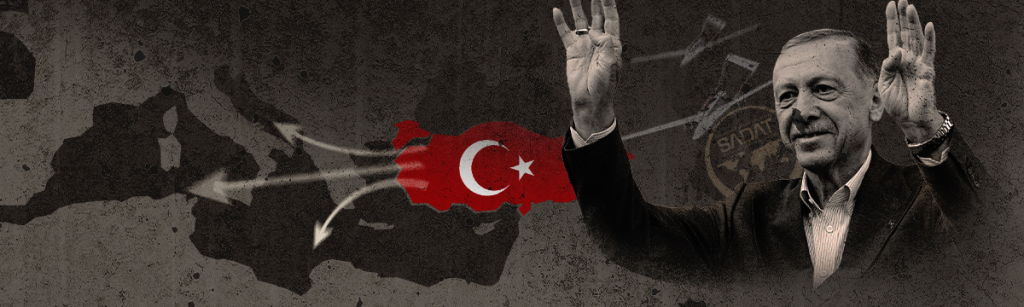
Since the early 2010s, Turkey has not merely widened its military reach; it has changed the way it projects war. In Syria, Libya, Nagorno-Karabakh, Qatar, Somalia and, more recently, across several parts of the Sahel, Ankara blends instruments that were once treated as separate: regular soldiers, drones, advisers, private companies, Syrian fighters recruited on contract, training agreements and equipment from its defence industry.
This combination answers a simple constraint. Turkey wants to act far from its borders, but its conventional army cannot be present everywhere without incur- ring political, human and diplomatic cost, Moreover, its NATO membership places constraints on certain forms of direct engagement. A Turkish soldier killed in an overseas operation creates immediate public accountability. By contrast, A Syrian fighter recruited under contract, moved through an intermediary network and then presented as a volunteer leaves room for denial.
It is in this space that SADAT International Defense Consultancy Inc. operates. Founded in 2012 by retired Brigadier General Adnan Tanrıverdi and twenty-two other former Turkish officers and non-commissioned officers, the company presents itself as a military consulting, training and logistics firm. Yet that commercial façade does not explain everything. SADAT is legally private, politically close to the Turkish government, ideologically distinctive, and its name resurfaces at every major episode of Turkey’s indirect projection1.
The central question, then, is the following: how does Turkey use SADAT, Syrian auxiliaries and exported military training to project power while lowering the political cost of direct involvement?
A purely strategic reading, however, leaves out what matters most for anyone interested in power relations: who profits from this system, and who pays for it? Behind the diplomatic flexibility lies a political economy. At the top, an expanding defence industry, tied to business networks close to the Justice and Development Party (AKP), captures profits and symbolic capital. At the bottom, impoverished Syrian fighters sell their labour and their lives for wages that are skimmed before they arrive, while civilians in the theatres concerned absorb a share of the cost. This article therefore follows two intertwined threads at once: the strategic device, and the ways in which it distributes wealth and risk.
Answering this question requires distinguishing established facts from allegations, because the sources are of uneven value. Some are official documents: communications from United Nations rapporteurs, US government reports, normative texts. Others come from Syrian organisations, investigative media or opposition actors. These are complemented by work on the political economy of the conflict, investigations into the Syrian combatant labour market, and data on the Turkish defence industry. The former set the frame. The latter shed light on the mechanisms but require caution when addressing clandestine operations2.