Drones, Civilians and Law in North Africa and the Sahel
Drones, Civilians and Law in North Africa and the Sahel: The “Hunter-Killer” Mode as a Structural Driver of Civilian Casualties
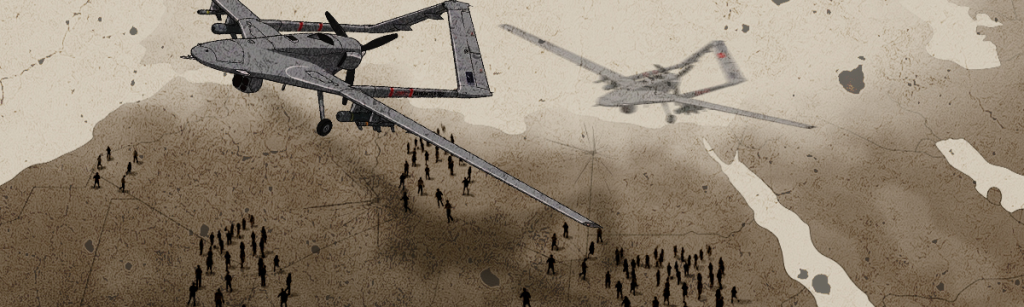
The admission came from a US Air Force general quoted by Gregoire Chamayou in his book A Theory of the Drone: “We’ve moved from using UAVs primarily in intelligence, surveillance, and reconnaissance missions before Operation Iraqi Freedom, to a true hunter-killer role with the Reaper (MQ-9).”(1) This transition, carried out by the American military in the mid-2000s, captures the central problem this article seeks to analyze. When a single platform both surveys and strikes, when the eye and the weapon become one, the temptation to strike what one sees without verifying its nature through other means becomes structural. Moreover, when this fusion occurs in zones where the operator has no ground presence, no human agent on the terrain capable of confirming or refuting an identification, the result is predictable : innocent civilians die.
But the problem is not merely technical. Chamayou identifies a deeper political logic at work: “the real advantage of unmanned aerial systems is that they allow you to project power without projecting vulnerability.”(2) This asymmetry is not incidental to drone warfare in the Sahel and North Africa. It is its organizing principle. The populations exposed to these strikes are nomadic herders in the Saharan desert, artisanal gold miners on remote tracks, villagers in the Malian interior. They share a common characteristic that has nothing to do with their legal status: they live in spaces where no state is able or willing to protect them, and where no institution exists to record what happens to them. The drone operates where accountability ends.
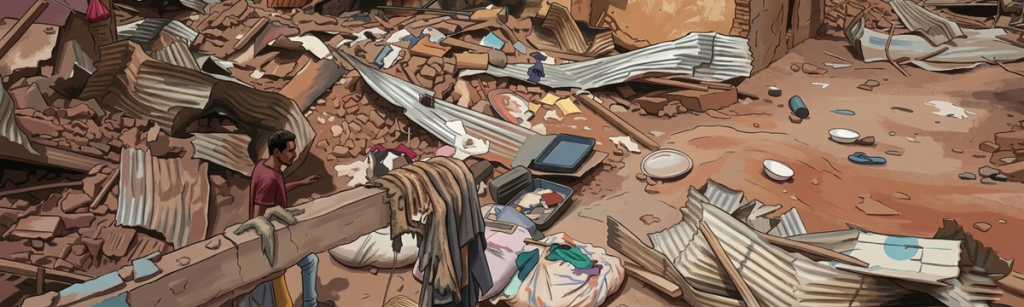
On January 3, 2021, in Bounti, in central Mali, drones from Barkhane operation struck a wedding gathering. Twenty-two people died, including sixteen civilians according to the MINUSMA investigation. Five presumed members of the Katiba Serma (a terrorist faction of the armed group JNIM) were present among approximately one hundred villagers. France had no ground forces in the Douentza cercle that day. The identification rested on aerial images and algorithmic analysis of behaviors observed from the sky. That is not sufficient. IHL has said exactly this since 1977, but without an enforcement mechanism that makes it effective for armies that choose to ignore it.
This article builds on this observation to defend a precise hypothesis: across the four theaters of the Sahelo-Maghrebian arc studied here, the combination of hunter-killer mode and the absence of ground control constitutes the principal structural driver of documented civilian casualties. The legal solution that flows from this hypothesis is not new general rules on drones, but a specific and binding norm: the prohibition of dynamic strikes on unknown targets identified behaviorally from the strike platform, in zones where the operator (or even the AI) has no ground presence capable of independently verifying the nature of the target.
The Hunter-Killer Mode: The Fusion of Eye and Weapon
The distinction between ISR (Intelligence, Surveillance, Reconnaissance) drones and armed UCAVs (Unmanned Combat Aerial Vehicles) is not merely technical. It is doctrinal and, in time, legal. A surveillance drone collects data and transmits it to analysts and decision-makers who evaluate, deliberate, and decide separately on the advisability of a strike. A hunter-killer does both in immediate sequence, often within minutes, with the same operator in the loop. The Royal United Services Institute (RUSI) notes that for ISR platforms without armament, “the aircraft could be sensibly operated by any qualified pilot,” whereas for combat UAVs, “the requirements of Rules of Engagement, Laws of Armed Conflict and a tactically fluid situation demand operators with skills that match those of a fighter pilot.”(3) This distinction in competence reveals a distinction in nature: striking is not surveilling.
What the doctrinal literature calls “dynamic targeting” or “opportunity strikes” constitutes the most problematic form of hunter-killer mode. The literature on drone strikes distinguishes deliberate strikes, planned in advance with a complete collateral damage assessment, from dynamic strikes, decided in a short time window on the basis of recent or time-sensitive information.(4) Research on American operations is unambiguous: “most collateral damage occurs when collateral damage mitigation is not observed, presumably primarily when operations are not pre-planned.”(5) Robert Sparrow adds to this from a different angle: “the capacities of drones encourage their use to strike individuals, and targets of opportunity more generally, in circumstances where a manned aircraft would not be employed.”(6) In this way,technological availability generates pressure toward use, regardless of the reliability of target identification.
Chamayou describes the cognitive logic that takes hold in this operational mode. “Pattern of life” analysis consists of “establishing a form or pattern of life that conforms with the paradigm of ‘activity-based information’”: the operator observes from the sky, identifies behaviors deemed anomalous, and strikes on the basis of this behavioral identification without precise identity confirmation.(7) This is not surgical precision. It is generic identification: not who this person is, but to which behavioral category their actions belongs. As Chamayou summarizes it, the best definition of an armed drone is probably the following “a high-resolution video camera equipped with missiles.”(8) When the camera and the missile are one, the temptation to confuse what is seen with what one must bestruck becomes structural.
This mechanism reveals a paradox that military doctrine rarely perceives. The drone is supposed to be more precise than a piloted aircraft because it can surveil a target for hours before striking. This prolonged surveillance,however;precisely because it is possible, broadens the range of practicable precautions and therefore the obligation to take them. Article 57 of Additional Protocol I requires taking “all feasible precautions.” In their article The International Law Framework Regulating the Use of Armed Drones, Professors Christof Heyns and Dapo Akande draw the logical consequence: “where drones are used for targeting, the technology and the way in which it is used ,in many cases, make long-term surveillance possible. This means that more information is available about targets and more information can be made available than might otherwise be possible. Therefore, the assessment as to what information is reasonably available should take into account the relative ease with which information can be acquired.”(9) This is not a question of moral risk for the operator; it is a question of technical capacity: if more precautions are practically possible, they become obligatory. Prolonged drone surveillance is not an expanded license to strike. It is a reinforced obligation to verify.
Four Theaters, One Logic
Western Sahara: 73 Strikes, Zero Ground Presence
This is the best documented case and the most revealing for the article’s central hypothesis. The Sahrawi Mine Action Coordination Office (SMACO) (a body operating under the Polisario) recorded 73 strikes by Moroccan drones between 2021 and 2023 in the territories east of the sand wall separating Moroccan-occupied territories from those “liberated” by the Sahrawis, causing 160 victims, including 80 deaths among Sahrawi, Algerian and Mauritanian nationals.(10) These figures represent the equivalent of 70% of deaths caused by drones over eight years across the four countries studied.
The geography of the strikes is instructive. The closest strike to the Moroccan wall occurred 18 kilometers from the demarcation line. The most distant strikes are located at Ain Bentili, 86 kilometers to the north, and at Ahfir, 100 kilometers to the south.(11) Morocco has no ground presence east of the berm: the 2,720-kilometer military wall, bristling with seven million mines, makes any Moroccan ground operation in these zones impossible.(12) Target identification therefore rests entirely on aerial surveillance.
The victim profile confirms the absence of military targeting. According to SMACO data, 58.4% were travelers on commercial routes, 36.3% were artisanal gold miners at extraction sites, and 5.3% were herders and nomads whose tents were struck.(13) Among victims linked to gold prospecting, 76.25% were Mauritanian nationals and 23.75% were Sahrawis. The report notes explicitly that “the attacks did not follow any suspicious behavioural pattern” and that “it was not possible to establish any relationship or link between the individuals killed and injured and the Sahrawi army.”(14) The conclusion is stated without ambiguity: “the pattern seems to be indiscriminate attacks on anything moving in liberated areas.”(15)
What the statistics do not capture is the lived experience under permanent drone surveillance in one of the world’s most isolated desert territories. According to SMACO’s field sources, frequent drone overflights east of the wall have generated constant fear of attack among the civilian population, not only among those directly in the strike zones, but also among families who have resettled in Mauritanian territory, just kilometers from the Sahrawi border, who report observing Moroccan drone flights overhead.(16) Nomadic families have modified their movements and abandoned traditional grazing routes. Gold mining, one of the few income sources available in these territories, has become a potentially lethal activity: 36.3% of all documented victims were engaged in artisanal mining when struck. The economic consequences extend well beyond the individual victims. SMACO documents the destruction of over 66 vehicles, including water tanker trucks supplying nomadic families and large commercial trucks, as well as the slaughter of hundreds of camels which represent the primary source of capital and livelihood for Sahrawi pastoral households.(17) Entire families have been left without income or basic resources for survival.
The displacement triggered by these attacks is also documented. According to the Sahrawi government, the drone campaign contributed to a massive exodus of the civilian population from the liberated territories to safer areas. At least two Sahrawi victims developed severe psychological illness following attacks in their vicinity.(18) This is not incidental to the military strategy. SMACO’s analysis suggests that one purpose of the attacks is precisely to instill terror and disrupt the movement of people and goods between neighboring countries, emptying the liberated territories of their civilian presence.
An objection deserves serious examination. Morocco might argue that strikes in these border areas follow a logic of economic blockade aimed at cutting off Polisario Front supplies, an argument not without precedent in IHL regarding dual-use objectives. But, IHL does not thereby authorize indiscriminate strikes against individuals in motion within a zone. Even a legitimately grounded economic blockade strategy would require strikes on identified objectives, with precautions to spare civilians. Yet, SMACO data describe exactly the opposite: shepherds whose tents are struck, Mauritanian and Sudanese nationals with no documentable link to the Polisario, and bodies left on the terrain for twenty-eight days because the victims’ relatives feared being targeted themselves if they tried to recover them.(19) If rescuers themselves constitute opportunity targets, the area-denial policy is indiscriminate by construction.
The SMACO 2024 report also documents the use of thermobaric munitions against civilian targets. These weapons produce a blast wave of significantly longer duration than a conventional explosive by consuming oxygen across an extended radius.(20) Their use under conditions of identification this uncertain constitutes, if confirmed by forensic analysis, a double violation: of the principle of precaution and of the prohibition of weapons whose effects cannot be limited to military objectives under the described conditions of use.
Northern Mali: Bounti as a Case Study
The Bounti strike is emblematic because it is the only case in which an independent UN investigation established the facts with sufficient precision. Barkhane had no ground presence in the Douentza cercle at the time of the strike. The identification of the gathering as a target rested on aerial surveillance and behavioral image analysis. Five presumed members of the Katiba Serma (a terrorist organization affiliated with JNIM, the Group for the Support of Islam and Muslims) were present among approximately one hundred civilians. The strike killed sixteen civilians and three presumed members of the armed group, and wounded eight others.
The village of Bounti is in the Mopti region, an area where state authority had been effectively absent for years before the strike. No French or Malian troops were stationed in the Douentza cercle. The population had been living with the aerial presence of Barkhane drones for months, knowing they were being observed but unable to know whether they would be struck. This is the lived reality of communities beneath the drone: permanent surveillance without any possibility of contesting one’s classification as a suspect, in a context where the state exercising lethal force over the territory has neither a physical presence nor any accountability to the people below.
The first legal question is proportionality. Article 51(5)(b) of Additional Protocol I prohibits attacks that may be expected to cause civilian casualties “excessive in relation to the concrete and direct military advantage anticipated.” For this strike to pass the proportionality test, the neutralization of five Katiba Serma fighters would need to represent a military advantage sufficient to justify the foreseeable death of sixteen to nineteen civilians in a gathering of one hundred people. Heyns and Akande note that “the risk to civilians may be exacerbated where drone strikes are carried out far away from areas of actual combat operations, especially in densely populated areas, where unsuspecting civilians may suddenly find themselves in the line of fire.”(21) France’s targeting doctrines, which are not public, make it impossible to verify that this test was correctly applied.
The second question is precaution in attack. Article 57 of the same Protocol requires “verifying that the objectives to be attacked are military objectives” and using “all information reasonably available.” If Barkhane had observed the Bounti gathering for hours before striking, which the drones’ prolonged surveillance capability made practically possible, it had sufficient time to confirm the nature of the target through independent means. It chose not to, or lacked the means because it had no ground presence. The legal corpus is clear on the limits of signature strikes under these conditions: “a determination that individuals are military-age males in an area of known terrorist activity does not provide a high degree of confidence that the individual is either a member of an armed group or that the person is taking a direct part in hostilities at that particular time. Indeed, mere presence in a given locality can never, in itself, amount to direct participation in hostilities.”(22) The presence of five presumed Katiba Serma members in a gathering of one hundred people does not convert the entire gathering into a military target.
The third question is the obligation of effective investigation. International humanitarian law, notably via Article 6 of the International Covenant on Civil and Political Rights (ICCPR), requires independent and public investigations into any death caused by State agents. The French internal investigation has never been made public. France contested the MINUSMA’s conclusions rather than opening a transparent procedure. In doing so, it illustrates exactly the model of impunity that drone strike doctrine structurally produces. The sixteen civilians of Bounti have no name in French public discourse, no legal recognition of their deaths, and no prospect of reparation. This silence is not a failure of process. It is the system functioning as designed.
The departure of Barkhane in August 2022 and the dissolution of MINUSMA in December 2023 removed both the best-documented operators and the only institutional mechanism for independent surveillance. Malian forces now operate with Bayraktar TB2s and Russian aircraft, in collaboration with Wagner personnel. Strikes on civilians have been reported since 2022 (Airwars, 2023-2024 reports), without it being possible to attribute each strike between Malian forces and Wagner with any certainty. Dione captures the dynamic in a precise formulation: the Sahelian space has become “a testing ground and lawless zone for unmanned aerial vehicles.”(23)
Libya: The Autonomous Hunter-Killer
Libya adds a further dimension to the hypothesis. The UN Panel of Experts report S/2021/229 notes that Kargu-2 systems were “programmed to attack targets without requiring data connectivity between the operator and the munition.”(24) This is the hunter-killer mode pushed to its logical conclusion: not only do the eye and weapon form one unit, but the human has been removed from the decision loop at the moment of the strike. Professor Annamaria Batori underlines, in her article International Criminal Law Issues of Autonomous Weapons: The Kargu-2 Drone in Libya, the legal consequences: if the lethal decision belongs to an algorithm, international criminal law has no grip, and command responsibility requires a knowledge of probable crimes that is difficult to establish for the emergent behaviors of systems whose autonomy may be unpredictable.(25) The ICRC drew the institutional conclusion in 2021: new and binding rules are necessary for systems capable of selecting and attacking human targets without intervention in the decision loop.(26) Ten years of negotiations within the Group of Governmental Experts of the Convention on Certain Conventional Weapons have failed to produce these rules.
Libya also functioned as a vector of diffusion: systems tested by the belligerents, whether in Tripoli or Benghazi, were subsequently sold to Morocco, Niger and Mali. Employment practices and doctrinal tolerances regarding target verification traveled with the hardware. The civilian populations of Western Sahara and the Malian interior are, in part, living with the consequences of a technological experiment conducted in Libya.
Sudan: The Least Documented, Most Alarming Case
The conflict between the Sudanese Armed Forces and the Rapid Support Forces, triggered on April 15, 2023, is the largest internal displacement crisis in the world, with more than ten million displaced persons by mid-2024 (UNHCR, July 2024). In his article Technopolitics of Conflict: Unpacking the Role of Drones in Sudan’s War, Shem Siteki observes, that the RSF have acquired drone strike capabilities enabling them to contest the SAF’s aerial superiority without traditional aviation.(27) Both belligerents have struck residential areas in Khartoum, in the northern districts of Omdurman, and in El Fasher, which were besieged between 2024 and 2025. The hunter-killer logic in uncontrolled ground zones is particularly manifested itself here: neither the SAF nor the RSF commands the adversary’s terrain, and drone strikes precisely constitute the substitute for that absence of ground presence.
The populations bearing the consequences of this dynamic are the urban residents of Khartoum, the communities of El Fasher, and the internally displaced people who have already fled previous rounds of violence in Darfur. They live under aerial threats they cannot anticipate, in a conflict that has effectively severed them from international attention. The scale of displacement and the death toll from aerial strikes on residential areas are documented only imprecisely, by journalists and humanitarian actors working under extreme constraints.
A Common Regional Pattern
Across these four theaters, a common political structure is at work, beneath the variations in actors, technologies and legal context.
In each case, lethal force is projected by an entity, state or para-state, that has chosen not to commit ground forces to the zone it is striking. This choice is not random. It reflects a political calculation: operating without ground presence limits exposure, limits casualties on the striking side, and limits accountability. As Chamayou observed, the drone allows power to be projected without vulnerability being projected.(28) The operator remains safe; the population below bears the entire risk. This is the fundamental asymmetry that connects the Moroccan army striking nomads east of the berm, Barkhane striking villagers in the Mopti region, and the RSF striking residential districts in Khartoum. The technological tools differ; the structural logic remains the same.
In each case, the affected populations belong to the margins of international visibility. They are Sahrawi nomads in territories that most of the world does not recognize; Malian villagers in a region where international media presence is near zero; Darfuri civilians in a conflict that has displaced ten million people but generates fewer headlines than smaller crises elsewhere. Their invisibility is not coincidental. Peripheral zones with weak governance and thin media coverage are, precisely, where these operations are concentrated. This is why accountability is so scarce: there is no one watching, no one recording, and no legal mechanism obliging the operators to explain themselves.
In each case, the supplier states – Israel, Turkey, the UAE, Russia, France and the United States – have delivered the means of remote lethal violence without conditioning those transfers on compliance with IHL standards, without publishing the terms of their end-use agreements, and without any documented mechanism for verifying how the systems are used in the field. The unequal distribution of power in the global arms market thus directly feeds the unequal distribution of risk and suffering on the ground.
This political economy of impunity is what the proposed legal norm is ultimately trying to address, even if it works through the narrower language of precautionary obligation and ground control. The norm matters not only as a technical rule of targeting doctrine, but as a mechanism of democratic accountability: it would require states to explain, in public, why they struck a target they could not verify, in a zone where they had no presence.
What the Law Says and Does Not Constrain
Drones are not illegal. Heyns and Akande establish this without ambiguity: “there is broad agreement that drones per se are not illegal weapons, in the sense of possessing characteristics that necessarily violate rules of international law.”(29) What is problematic is their mode of employment in specific contexts.
The principle of precaution in attack is the provision most directly relevant to this article’s hypothesis. Article 57 of Additional Protocol I requires commanders to “verify that the objectives to be attacked are military objectives” and to use “all feasible precautions.” The key lies in the qualifier: what is feasible depends on available capabilities. For a pilot under enemy fire, feasible precautions are limited by urgency and risk. For a drone operator surveilling a target for hours with no personal risk, the field of feasible precautions is considerably extended. This is what Heyns and Akande formulate precisely: “the assessment as to what information is reasonably available should take into account the relative ease with which information can be acquired.”(30) A drone’s prolonged surveillance capacity does not create an expanded license to strike. It creates a reinforced obligation to verify.
The principle of distinction prohibits striking anyone who has not been identified as a combatant or a direct participant in hostilities. An identification based on observing behavior from an altitude of several thousand meters, in a desert space where adult men move, work, trade and travel, does not satisfy the required identification standard. The legal corpus is explicit: signature strikes based on “biological factors, such as males between the age of 20 and 40” necessarily raise the question of “how many of those individuals are, in fact, civilians.”(31) Mere presence in a zone of suspected activity is never sufficient.
On the question of LAWS (Lethal Autonomous Weapons Systems) in Libya, current international criminal law has no grip once the lethal decision belongs to an algorithm.(32) On the responsibility of supplier states, Article 16 of the ILC Articles on State Responsibility engages the responsibility of a state that “aids or assists” another in committing an internationally wrongful act. This avenue has never been submitted to an international tribunal in this context.
Rosa Brooks identified, in her article Drones and the International Rule of Law, the underlying mechanism by which states circumvent these obligations: they deliberately blur the concepts of combatant, direct participant in hostilities and legitimate target in order to construct a space of continuous military action that existing law cannot easily qualify.(33)
The Missing Norm: Prohibiting Opportunity Strikes in Uncontrolled Zones
The analysis of the four cases leads to a precise legal proposal.
The specific problem identified in this article is not that drones bomb and kill. It is that they strike unknown opportunity targets, identified behaviorally from the surveillance platform that will strike them, without independent verification, in zones that the operator does not control on the ground. This configuration corresponds to an identifiable normative gap: no existing international law instrument explicitly prohibits dynamic strikes on targets not confirmed by means independent of the strike platform.
The norm that can be derived from existing IHL principles, without inventing a new rule but by drawing the logical consequences of Article 57 of Additional Protocol I, is the following: any dynamic strike on an unknown target identified behaviorally in a zone not controlled on the ground must be preceded by verification of the target’s nature by means independent of the platform that carried out the identification. This independent means may be a ground presence, a human source (HUMINT), a second distinct observation system, or an authorization procedure involving a command level in possession of distinct sources.
This norm requires two important clarifications.
The first concerns its scope of application. It does not target deliberate strikes on nominally identified targets (personality strikes) whose prior verification was conducted through independent sources. An army may strike a known combatant, even in an uncontrolled zone, provided the identification was established by sources other than the strike platform itself. What the norm prohibits exclusively is the strike on an unknown target identified behaviorally from the same aircraft that will destroy it: the Bounti case and the Western Sahara truck drivers.
The second clarification concerns the definition of “ground control.” This concept has no existing legal definition in the international law of armed conflict, and its imprecision would be a fatal weakness of the norm if left unresolved. The case law of international criminal tribunals offers a useful anchor here. In the ICTY’s Tadic ruling (1995), the Appeals Chamber defined territorial control not as formal sovereignty but as the capacity of an armed group to conduct sustained and concerted military operations in an area.(34) Transposed to the proposed norm, “ground control” for the drone operator should be defined functionally as the documented capacity to deploy ground forces in the relevant zone and conduct verification operations there within a reasonable timeframe. An army that strikes from the air a zone where it cannot send a single soldier, as Morocco does east of the berm, or as Barkhane did in the Douentza cercle in January 2021, does not satisfy this criterion. This definition is operational, anchored in existing case law, and resistant to circumvention through the mere invocation of formal sovereignty.
The distinction between deliberate and dynamic strikes is already known to military doctrine.(35) What this article proposes is to elevate to a rule of international law what the most rigorous armies already apply as internal doctrine: the prohibition of treating as a deliberate strike an opportunity strike on an unknown target not verified by means independent of the strike platform. Across the four theaters of this article, this rule would have rendered illegal the Bounti strike, the 73 documented strikes in Western Sahara, and the Sudanese strikes on residential areas that neither belligerent controls on the ground.
Conclusion
Dr. Songho Faye Dione summarizes the drift in a formulation worth quoting: we are moving “from detention without trial to execution without trial.”(36) The hunter-killer logic in uncontrolled ground zones is the instrument of this drift. It eliminates suspects without identifying them with certainty, strikes opportunity targets without confirming them through independent means, and leaves survivors without recourse in zones inaccessible to investigators.
The available data demonstrate this across four theaters. In Western Sahara, seventy-three strikes in three years on travelers, gold miners and herders that Morocco cannot distinguish from combatants because it has no ground presence in these zones. In Mali, sixteen civilians killed in a gathering that Barkhane did not verify through independent means because it had no ground presence in the sector. In Libya, systems that may have crossed the boundary between guided weapon and an autonomous weapon. In Sudan, two belligerents striking from the air zones that neither controls on the ground.
IHL principles are sufficient to qualify these practices. The precautionary obligation of Article 57 of Additional Protocol I, interpreted in light of the actual capabilities of modern drones and the case law on effective territorial control, prohibits unverified dynamic strikes in uncontrolled zones. What is missing is the political will to write this explicitly into a binding instrument and to create the mechanisms that would make it enforceable.
But the legal norm alone is not enough. The structural conditions that make these strikes possible and largely invisible also need to be addressed. Three political accountability measures deserve particular attention alongside the legal proposal.
Transparency of targeting doctrines is the most immediate. States that operate armed drones should be legally required to publish their targeting procedures and the verification standards they apply before any strike. This would allow the gap between stated doctrine and actual practice to be publicly examined, and would give civil society, parliaments and regional organizations the information needed to exercise meaningful oversight. The sixteen civilians of Bounti died partly because France’s targeting doctrine is classified. That classification is a political choice, not a military necessity.
Democratic oversight of arms transfers is the second dimension. The supplier states – Israel, Turkey, the UAE, Russia, France and the United States – should be required to condition drone transfers on documented compliance with IHL precautionary standards, and to report publicly on end-use monitoring. The current system, in which advanced lethal systems are sold or donated with no enforceable accountability for their use, directly enables the pattern of impunity described in this article. Regional bodies including the African Union, ECOWAS, and the Arab League should develop transfer frameworks that go beyond the current voluntary commitments under the Arms Trade Treaty.
The role of regional civil society is the third. Organizations like SMACO are doing work that no state institution does: documenting strikes, recording victims, mapping patterns of violence in territories that the international system has effectively abandoned. Their capacity to investigate, to publish, and to bring evidence to legal and political forums should be systematically supported. The normative gap this article identifies cannot be closed without the empirical record that only independent ground-level documentation can provide.
The French-language academic literature on this subject remains sparse. The populations most directly affected by the practices described here are also the least represented in international normative debates. This imbalance will not correct itself without sustained investment in field research conducted from within the region, and without the active inclusion of Sahrawi, Malian, Sudanese and Sahelian voices in the legal and policy conversations where the rules governing their lives are being written.
Notes
- Chamayou (G.), A Theory of the Drone, translated by Janet Lloyd, New York, The New Press, 2015, p. 12.
- Chamayou, op. cit., p. 13.
- Quintana (E.), The Ethics and Legal Implications of Military Unmanned Vehicles, RUSI/BCS, 2009, p. 20.
- Krishnan (S.), “The Ethics of Drone Warfare,” Journal of Seedling School of Law and Governance, 2015, pp. 27-28; Wheat (T.L.), America’s Imperfect War: The Ethics, Law, and Strategy of Drone Warfare, doctoral dissertation, University of Tennessee, 2017, p. 167.
- Krishnan, op. cit., p. 27.
- Sparrow (R.), “Ethics of Drone Strikes,” in Enemark (C.) ed., Ethics of Drone Strikes: Restraining Remote-Control Killing, Edinburgh University Press, 2021, p. 22.
- Chamayou, op. cit., p. 43.
- Chamayou, op. cit., p. 12.
- Heyns (C.), Akande (D.), Hill-Cawthorne (L.) and Chengeta (T.), “The Right to Life and the International Law Framework Regulating the Use of Armed Drones,” International and Comparative Law Quarterly, 2016, pp. 22-23.
- SMACO, Annual Report 2024, p. 3.
- SMACO, Annual Report 2024, section “Geographical and Temporal Patterns of the Attacks.”
- SMACO, Annual Report 2024, p. 5.
- SMACO, Annual Report 2024, section “High Risk Activities.”
- SMACO, Annual Report 2024, section “High Risk Activities.”
- SMACO, Annual Report 2024, section “High Risk Activities.”
- SMACO, Annual Report 2024, section “Side Effects.”
- SMACO, Annual Report 2024, section “Material Losses.”
- SMACO, Annual Report 2024, section “Side Effects.”
- SMACO, Annual Report 2024, section “Evacuation of Victims” (case of Embarec Sbaii).
- SMACO, Annual Report 2024, section “Use of Thermobaric Weapons on Civilian Targets.”
- Heyns et al., op. cit., p. 22.
- Heyns et al., op. cit., p. 23.
- Dione (S.F.), “L’usage de drones dans la lutte contre le terrorisme dans l’espace CEDEAO,” R.I.D.S.P., vol. 3, no. 7, 2023, p. 49.
- United Nations Security Council, S/2021/229, para. 63.
- Batori (A.), “International Criminal Law Issues of Autonomous Weapons: The Kargu-2 Drone in Libya,” Gradus, vol. 12, no. 1, 2025, pp. 2-4.
- ICRC, Statement before the GGE-LAWS, CCW, August 3, 2021.
- Siteki (S.), “Technopolitics of Conflict: Unpacking the Role of Drones in Sudan’s War,” Journal of Peace and Diplomacy, vol. 6, no. 2, 2025, p. 84.
- Chamayou, op. cit., p. 13.
- Heyns et al., op. cit., p. 3.
- Heyns et al., op. cit., pp. 22-23.
- Krishnan, op. cit., p. 26.
- Batori, op. cit., pp. 2-4.
- Brooks (R.), “Drones and the International Rule of Law,” Ethics and International Affairs, vol. 28, no. 1, 2014, pp. 84-88.
- ICTY, Prosecutor v. Dusko Tadic, Appeals Chamber, judgment of October 2, 1995, para. 70, cited in Heyns et al., op. cit., note 64.
- Krishnan, op. cit., p. 27; Wheat, op. cit., p. 167.
- Dione, op. cit., p. 45.
Selected Bibliography
Batori (A.), “International Criminal Law Issues of Autonomous Weapons: The Kargu-2 Drone in Libya,” Gradus, vol. 12, no. 1, 2025.
Besenyő (J.) and Málnássy (A.), “Geopolitical Dimension of Libyan Drone Warfare: The Use of Turkish Drones on the North African Battlefields,” Obrana a Strategie, vol. 24, no. 1, 2024, pp. 3-17.
Brooks (R.), “Drones and the International Rule of Law,” Ethics and International Affairs, vol. 28, no. 1, 2014, pp. 83-104.
Chamayou (G.), A Theory of the Drone, translated by Janet Lloyd, New York, The New Press, 2015.
Dione (S.F.), “L’usage de drones dans la lutte contre le terrorisme dans l’espace CEDEAO: quelles perspectives d’encadrement par le droit?,” Revue internationale de droit et science politique, vol. 3, no. 7, July 2023, pp. 38-76.
Heyns (C.), Akande (D.), Hill-Cawthorne (L.) and Chengeta (T.), “The Right to Life and the International Law Framework Regulating the Use of Armed Drones,” International and Comparative Law Quarterly, 2016, pp. 1-42.
Krishnan (S.), “The Ethics of Drone Warfare,” Journal of Seedling School of Law and Governance, 2015.
MINUSMA, Report on the Bounty Incident of January 3, 2021, Human Rights and Protection Division, March 2021.
Quintana (E.), The Ethics and Legal Implications of Military Unmanned Vehicles, RUSI/BCS, 2009.
Siteki (S.), “Technopolitics of Conflict: Unpacking the Role of Drones in Sudan’s War,” Journal of Peace and Diplomacy, vol. 6, no. 2, 2025, pp. 72-105.
SMACO, Annual Report 2024: The Effects of Moroccan Unmanned Aerial Vehicles (Drones) Attacks Against Civilians in Western Sahara, 2024.
SMACO, Silence in the Face of Cruelty: Moroccan Drone Massacres in Western Sahara, [circa 2022].
Sparrow (R.), “Ethics of Drone Strikes,” in Enemark (C.) ed., Ethics of Drone Strikes: Restraining Remote-Control Killing, Edinburgh University Press, 2021, pp. 11-28.
Wheat (T.L.), America’s Imperfect War: The Ethics, Law, and Strategy of Drone Warfare, doctoral dissertation, University of Tennessee, 2017.
United Nations Security Council, Final Report of the Panel of Experts on Libya, S/2021/229, March 8, 2021. ICTY, Prosecutor v. Dusko Tadic, Appeals Chambe