Seeds of Dependency: The Silent War on Food Sovereignty in Tunisia
On his small farm in the region of Zaghouan, a 70-year-old farmer stands before a wooden box inherited from his father. The box holds small cloth bags, each containing seeds of crops that have been cultivated for decades on the family’s land: tomatoes, summer barley, fava beans, onions… These seeds are not merely tools of production; they represent a living memory, a legacy of the land, of knowledge, and a way of life passed down through generations. Yet, as the farmer explains, they have become worthless: “The state does not recognize them, the market does not demand them, and the law criminalizes their exchange.”
What the farmer expresses is not an isolated crisis, but rather a reflection of a profound structural shift in Tunisia’s agricultural policies: a shift that has turned seeds into instruments of gradual dispossession, stripping farmers of their autonomy, their knowledge, and their sovereignty.
Over the past decades, Tunisia has undergone a political and economic trajectory that has reshaped the state’s relationship with agriculture. This transformation occurred not only through the reduction of direct public support or the privatization of certain mechanisms, but more critically through a progressive submission to the logic of open markets and the conditions imposed by international financial institutions.
In the early 1980s, amidst a suffocating debt crisis, the Tunisian government accepted the terms of the International Monetary Fund and the World Bank under the Structural Adjustment Program. This program required the liberalization of trade, the dismantling of the subsidy system, and the gradual withdrawal of the state from its productive roles, particularly in the agricultural sector. These reforms were promoted as essential steps toward “modernization” and increased “economic efficiency.” However, at their core, they redistributed power within the agricultural sphere in favor of corporations and foreign interests at the expense of local farmers.
One of the most significant transformations has been the redefinition of “seeds” within the legal and policy framework. Once a shared resource freely exchanged among farmers, seeds were subsumed under the logic of private property and subjected to imported legal standards that grant exclusive rights of production and distribution to selected companies[1].
Law No. 99-42, published in the Official Gazette in 1999[2], made it mandatory to register seeds in the official catalog of approved varieties in order for them to be legally traded. In practice, this meant that farmers could no longer exchange their traditional seeds unless those seeds met specific technical standards, standards that neither reflect local specificities nor account for traditional agricultural diversity. As a result, the exchange of local seeds has become a legal offense, even though these seeds are often better adapted to the environment and require less water and fewer chemical inputs.
This transformation can only be understood within the broader context of increasing legal dependency. Tunisia has gradually integrated into an international legal framework that enshrines intellectual property rights over agricultural resources, adopting international agreements without social accountability or public debate regarding their implications.
The Tunisian state has embraced these external legal frameworks at an accelerating pace, as evidenced by the timeline of treaty ratifications and legislative amendments, a trajectory that represents the systematic dispossession of farmers from their sovereignty over agricultural resources, and entrenches political and economic subordination to the dictates of the global trade regime.
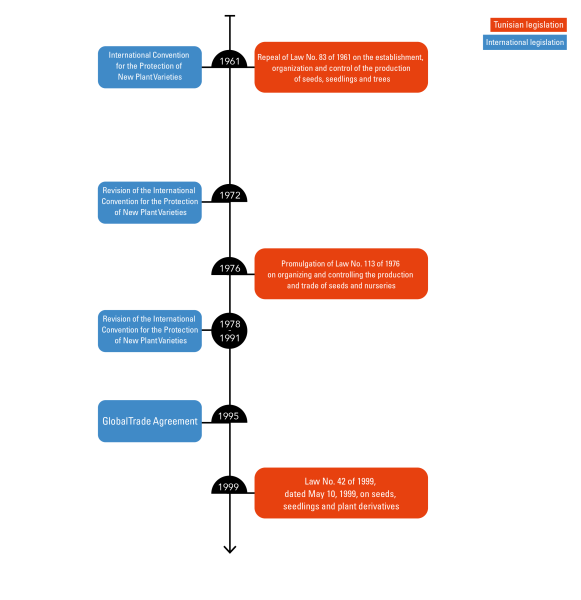
From Sovereignty to Subordination: The evolution of the legal framework for seeds in Tunisia under the influence of international agreements
This legal exclusion of local seeds has not occurred in isolation. It is closely tied to broader economic policies aimed at integrating Tunisian agriculture into global production chains. Farmers are now compelled to purchase hybrid and seasonal seeds produced by multinational corporations such as Monsanto[1] and Syngenta[2]—often through local intermediaries supported by “agricultural modernization” programs funded by the European Union and the African Development Bank.
These seeds come as part of an entire production package that includes chemical fertilizers, pesticides, intensive irrigation technologies, and export-oriented markets. In this way, farmers have been bound to a production system over which they have no control, neither over its inputs nor the terms under which their products are sold—making them more vulnerable and less resilient in the face of climate or economic crises.
These policies have been accompanied by official narratives promoting the ideas of “agricultural modernization” and “increased productivity,” particularly within the walls of agricultural institutes and universities. These narratives rely on a technical language that disregards the social and sovereign dimensions of agricultural practices.
No questions have been raised about who controls agricultural decision-making, who sets production priorities, or what becomes of small-scale farmers within this framework. Within such a discourse, local varieties have been neglected, traditional farmers demonized, and inherited agricultural knowledge portrayed as an obstacle to “progress.”[3]
From a public policy perspective, it is clear that the Tunisian state has, whether consciously or as a result of structural dependency, adopted a logic that links food security to productivity and external markets. Over the past three decades, the Ministry of Agriculture, under the influence of partnership agreements with the European Union and commitments to the World Trade Organization, has focused on supporting export-oriented crops (such as tomatoes, strawberries, citrus fruits, and olives) at the expense of staple crops like cereals and legumes[4]. These choices were not merely technical priorities; they reflected a deeper submission of agricultural policymaking to a logic that does not prioritize food sovereignty, but rather favors alignment with external demand, even at the cost of depleting natural resources, especially water, and increasing dependence on imported inputs.
In this context, the issue of seeds is a stark indicator of the nature of the relationship between the state and farmers. When agricultural policies are formulated without the participation of farmers or consideration of their knowledge and experience, the land is reduced to a mere site of production, the farmer to a simple executor, and sovereignty to a hollow slogan. The marginalization of local seeds does not simply mean the loss of an agricultural resource, it entails the loss of the ability to act independently, to produce food in accordance with local ecological rhythms and the needs of the population. Moreover, the disappearance of these seeds undermines agricultural biodiversity and renders the national food system more vulnerable to climate change and economic crises.
In response to this reality, local grassroots initiatives have emerged in resistance—though they often operate on the margins, disconnected from official policy. There are women’s farming cooperatives working to collect traditional seeds, informal networks of seed exchange among farmers, and research projects supported by environmental organizations aiming to restore value to local agricultural knowledge[5]. Although these initiatives remain limited in scale, they represent a different vision—one that treats seeds not as commodities, but as a collective right and a pathway toward food sovereignty and social justice. However, under the current legal framework, such initiatives remain vulnerable to criminalization and lack the political and institutional support needed to transform them into a national strategy.
Seed sovereignty is not a technical issue—it is profoundly political[6]. It concerns a society’s right to define its own agricultural and food choices, and to control the means of production and distribution. Food sovereignty cannot be achieved without reclaiming control over seeds and recognizing the strategic value of farmers’ knowledge. If current public policies are guided solely by market logic, then resisting this logic requires a broad alliance of farmers, researchers, and activists to defend the right of communities to produce their food freely and autonomously.
The future of agriculture in Tunisia cannot be measured solely by the volume of exports or the advancement of agricultural technologies. It must also be assessed by the extent to which farmers retain the right to choose what they grow, by the diversity of our agricultural system, and by the possibility of creating alternative production pathways that are more just, equitable, and sustainable. The recovery of local seeds is not merely a cultural or environmental demand—it is a fundamental condition for reclaiming national decision-making power in a vital and strategic domain such as food.
[1] https://www.bayer.com/e
[3] Projet de plan strategique du systeme de la recherche et del’enseignement superieur agricoles, IRESA https://iresa.agrinet.tn/wp-content/uploads/2023/10/Plan_Strategique_SRESA_Version_detaillee-1.pdf
[4] https://www.gil.com.tn/uploads/FCK_files/variation%20des%20exportations%202014.pdf
[5] https://osae-marsad.org/2023/09/26/policy-insights-from-farmer-seeds-2023-project-nurturing-food-sovereignty/
[6] قيس سعيّد أمام امتحان السيادة الغذائية: خطابات دسمة أم سياسات أقوم؟هيثم قاسميhttps://nawaat.org/2023/10/24/قيس-سعيّد-أمام-امتحان-السيادة-الغذائي/