Seeds as Instrument of Domination: The Erosion of Sovereignty in Egyptian Agriculture
Introduction
At the heart of food sovereignty debate, no issue captures the challenge more vividly than that of seeds. This is far from a mere technical detail or basic production input—it lies at the core of a deeper conflict between two agricultural paradigms: one rooted in small-scale farmers knowledge and local seed varieties, and another shaped by global capitalist agriculture, which subjects food to the logic of markets, property rights, and imported, privately owned seeds.
Eroding Local Seed Systems
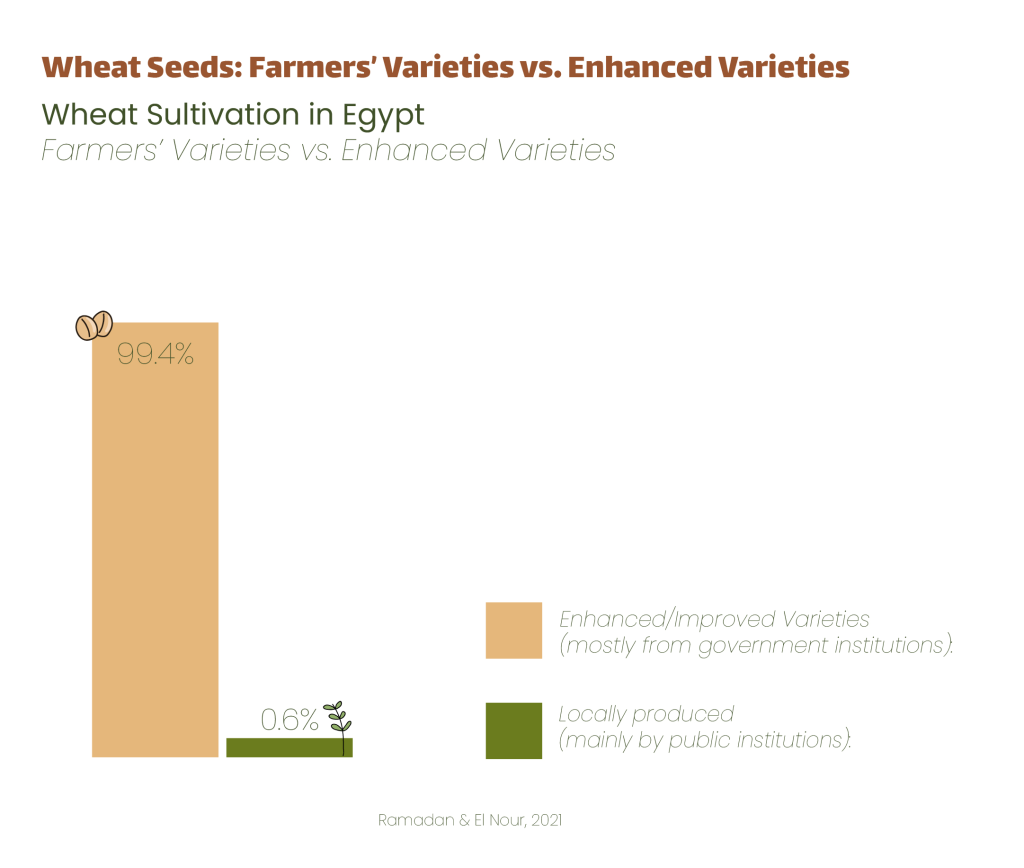
For decades, Egypt’s capacity to produce and exchange seeds has been systematically eroded by agricultural policies that foster dependency and weaken farmers’ ability to reproduce seeds, form cooperatives, or establish local seed banks. Field data show that approximately 99.4percentof wheat cultivated in Egypt relies on improved or hybrid seeds, sourced primarily from state institutions or private companies. In contrast, only 0.6percentof wheat fields are sown with local varieties—a figure that reflects not only the decline of agricultural biodiversity but also the deliberate marginalization of small-scale farmers’ knowledge and local seeds (Ramadan and El Nour, 2021).
While the state remains a major producer of field crop seeds, particularly for wheat, rice, and corn, the crisis becomes most evident in the case of vegetable seeds, which are widely cultivated in small-scale farming systems. Between 2016 and 2018, Egypt imported approximately 1,350 metric tons of vegetable seeds (excluding potatoes). The Egyptian vegetable seed market is evaluated at an estimated 70-80 million US dollars annually, accounting mainly for tomatoes, cucumbers, peppers, squash, watermelons, beans, and peas (USDA, 2019).
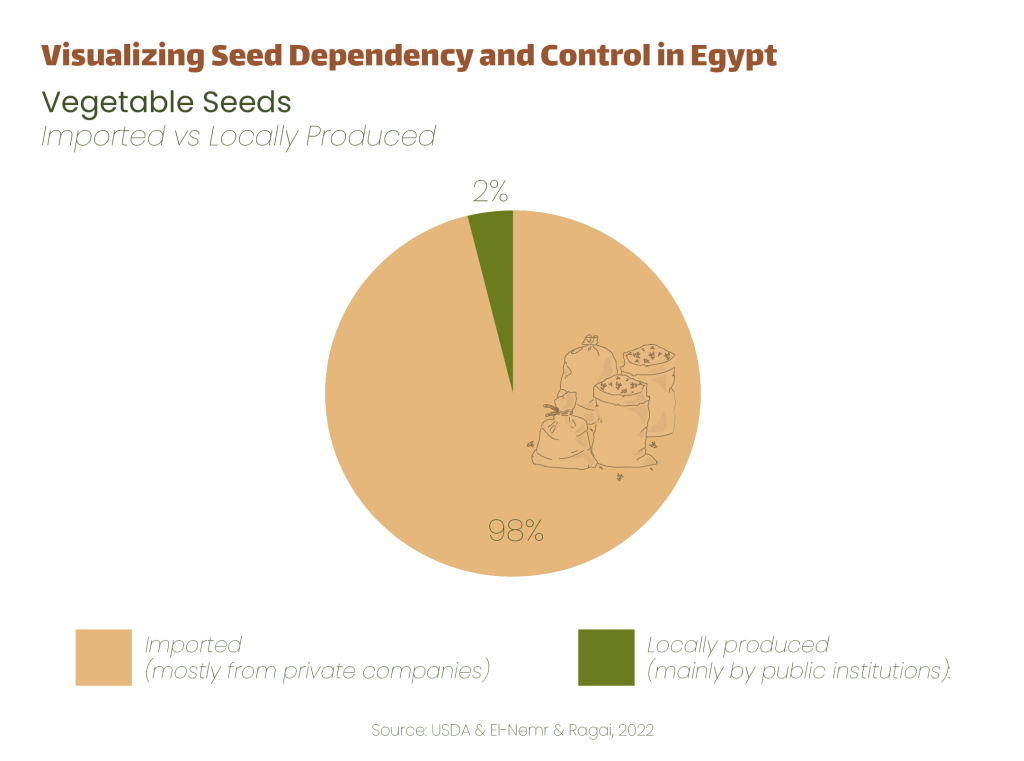

Egypt imports approximately 98percent of its vegetable seeds, which alone accounts for 59.3percent of the country’s total agricultural seed imports. By comparison, field crop seeds make up 31.8 percent , fruit seeds 7.6 percent, and seeds of medicinal and aromatic plants only 1.3 percent. In 2019, over 80 percent of Egypt’s vegetable seed imports originated from six countries: the United States (20.3percent), China (16.6percent), Thailand (14.5percent), India (13.7percent, Brazil (7.8percent), and Chile (7.2percent) (El-Nemr and Ragai, 2022).
What stands out in this market is the overwhelming dominance of imported seeds linked to high-input agricultural models and global supply chains, leaving small farmers entirely dependent on multinational seed companies, their local agents, and distributors. These actors not only supply seeds and inputs but often control markets and purchase from farmer at depressed prices. The shift from state-led systems to corporate monopolies has occurred without any real effort to localize seed technologies, preserve native varieties, or establish cooperative seed banks. Consequently, crops such as vegetables, potatoes, and sugar beets, which once provided flexibility and income for small-scale farmers, have become additional pressure points in a widening cycle of agricultural dependency, undermining prospects for food self-sufficiency or seasonal autonomy.
Legal Instruments of Seed Control
This situation cannot be separated from the state’s legal and regulatory trajectory—most notably Egypt’s parliamentary approval in 2017 (Presidential Decree No. 84/2017) to accede to the International Convention for the Protection of New Varieties of Plants (UPOV). Egypt formally joined in November 2019, during the 53rd session of the UPOV Council in Geneva.[1]
Accession was driven by both external and internal forces. Externally, obligations under the 2007 EFTA–Egypt Free Trade Agreement (Annex V) generated sustained European pressure to join UPOV (GRAIN, 2014). Internally, influential agribusiness elites—including figures controlling the Agriculture Committee in parliament—saw accession as a strategic opportunity to open the seed market to foreign investment. As the Ministry of Foreign Affairs stated, accession “allows Egypt to benefit from cultivating foreign plant varieties in the country and serves as an incentive for foreign investment in activities related to seed production and the breeding of new plant varieties” (State Information Service, 2019).
In the wake of UPOV accession, Auckland Imcocall, the legal representative of the University of Florida in Egypt for intellectual property rights over its strawberry seedlings, blocked Egyptian strawberry exports, invoking plant variety protection rather than patents. The company imposed royalties on certain varieties, reduced from $18 to $12 per exported ton (Misr El-Zraea, 2022). This move threatened the livelihoods of thousands of small-scale farmers who rely on informal seed saving and local propagation.
The situation is even more complex for contract crops such as potatoes and sugar beets, grown primarily for export or processing. Seeds for these crops are entirely imported from Europe and sold at high prices, often within contract farming schemes that strip farmers of agency and bind them to predefined production plans and prices.
Today, many farmers find themselves trapped in a cycle of forced seasonal purchases, unable to control the means or terms of their own production. Some are compelled to reuse hybrid seeds, despite their declining productivity over time—a practice locally referred to as “seed breakage.” This is not a rational choice but an imposed necessity, exacerbated by the absence of support for local seed systems and the lack of viable alternatives.
Reviving Traditions and Local Food Circuits
Across Egypt, alternative pathways persist. In areas like Fayoum, women-led farming households sustain local food circles through informal exchanges of seeds and seasonal produce. On the urban outskirts of Cairo—such as Dar El Salam and Ezbet El Nakhl—vegetables are cultivated on rooftops and sold directly in neighborhood markets or distributed via trust-based community networks. This revival of balady (local) crops and dishes reflects a growing appreciation for traditional food knowledge, cultural heritage, and nutritional value.
Field observations reveal that vegetables grown on very small plots for household consumption—such as okra, jute mallow (molokhia), cress, onions, and garlic—are among the few crops where farmers, especially women, maintain seed sovereignty. Women play a central role in selecting, saving, and exchanging these seeds, which continue to circulate through informal kinship and neighbor networks. These short food circuits, built on proximity and reciprocity, challenge the extractive paradigm of industrial agriculture and sustain micro-economies of autonomy. They demonstrate that reclaiming food and seed systems is not only necessary but already underway. However, scaling and sustaining such practices will require political commitment, legal protections for farmer autonomy, and a shift in governance toward people-centered agriculture policy.
Conclusion: A Question of Sovereignty
Seed sovereignty lies at the core of food sovereignty. Seeds are not merely the starting point of the production cycle—they embody the convergence point of memory, identity, and the right to self-determination. When small-scale farmers are denied the ability to choose what to plant, to save and exchange their own seeds, and are forced to depend on external inputs beyond their control, this does not represent development—it is social engineering that severs communities from land, knowledge, and life.
In the face of deepening ecological and food crises, defending local seeds and their custodians transcends technical concerns—it is fundamentally matter of sovereignty, justice, and survival.
References
- El‑Nemr, Hoda, and Ragai, Hanan. Deepening Local Production of Vegetable Seeds. National Planning Institute, Nov 2022.https://is.gd/7wnrqh
- Ramadan, Mohamed, and El Nour, Saker. Bread Merahrah: The Political Economy of Food Sovereignty in Egypt. Dar Safsafa, 2021.
- USDA Foreign Agricultural Service. Egypt Planting Seeds Sector Overview, 2019.https://is.gd/dTMVWu
- State Information Service. Egypt deposits its instrument of accession to the International Union for the Protection of New Varieties of Plants (UPOV). State Information Service, Nov 3 2019. https://shorturl.at/O0KgP
- GRAIN. Trade agreements privatising biodiversity. GRAIN, Nov 2014. https://shorturl.at/Rt3uG
- Misr El-Zraea. University of Florida: “Auckland Imcocall” is our representative for collecting royalty fees on strawberry seedlings in Egypt. Misr El-Zraea, Apr 11 2022. https://shorturl.at/kZSOq