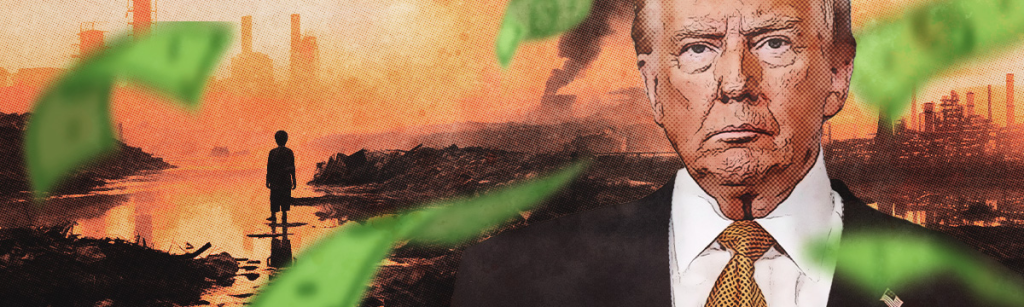
How Climate Summits Are Emptied of Their Substance
How Climate Summits Are Emptied of Their Substance: A Reading of Capital Domination and Conflicting Interests
On the remote island of Tuvalu in the South Pacific, a man stands on a shoreline that erodes with each passing day, watching as the waves inexorably consume his land. Half a world away, another man sits in a plush office atop one of Wall Street’s towers in New York, signing oil deals that swell his profits, utterly indifferent to the environmental havoc wrought by this relentless economic expansion. This stark juxtaposition not only reflects the deep inequality in how the climate crisis impacts people, but also reveals a deeper dilemma: Why do major industrialized countries persistently defer any genuine commitment to combating climate change, despite dozens of climate summits and international agreements?
Since the 1972 Stockholm Conference, slogans such as “environmental justice” and “sustainable development” have been invoked time and again repeatedly, yet climate summits have so far failed to impose binding commitments on powerful nations. Entangled in the economic interests of fossil fuel corporations and beset by the influence of lobbying groups, these summits have have devolved into little more than diplomatic stages, where the same promises are endlessly recycled—while climate disasters escalate at a pace that far outstrips humanity’s ability to respond. If any evidence were needed to demonstrate the impotence of these summits in holding major powers accountable, it is the United States’ repeated withdrawal from the Paris Agreement—first in 2017, and again in 2025 after Donald Trump’s return to office. This decision was not merely a political maneuver; it was a stark manifestation of the lack of political will in the world’s largest economy, and a blatant display of the profound dysfunction at the core of international climate law.
International Climate Law and Its Failings
When Donald Trump justified his first withdrawal by saying, “I was elected to represent the people of Pittsburgh, not Paris,” he reinforced a worldview in which international environmental commitments are subordinated national profit-and-loss calculations, rather than global climate concerns. His second withdrawal in 2025 was not merely a reprise of an earlier decision; it was a clear confirmation that climate commitments would remain hostage to economic interests, even at the cost of the planet’s sustainability. Trump made this perspective explicit in 2022 during the annual leadership conference of the Heritage Foundation in Florida, stating: “The world is not ending. Our future is not dead. We must defeat the climate change hoaxers. They used to call it global warming, but that didn’t work… so they changed it to climate change. Temperatures can go up, they can go down, they can go in 15 different directions. It’s just weather change.”
The repercussions of the U.S. withdrawal has not been limited to Washington. Rather, they have emboldened other nations to reconsider their climate commitments. While no other state has yet formally exited the 2015 Paris Agreement, which currently counts 194 signatories in addition to the European Union, there are mounting indications that Argentina may be the first to follow the U.S. lead. President Javier Milei’s government has announced its intention to review its commitments to the agreement, amid rising controversy following the abrupt withdrawal of the Argentine delegation from the COP29 Climate Summit. Milei—known for his staunch pro-capitalist economic positions—has openly expressed doubts about climate change, echoing Trump’s rhetoric. He went as far as to denounce it as a “socialist hoax,” a view entirely consistent with his broader hostility to environmental regulations.
Under Article 28 of the Paris Agreement, any country may withdraw after three years from the agreement’s entry into force on its territory. This means Argentina could be on track to take an unprecedented step—one that could further undermine already fragile trust in global climate commitments. Thus, the U.S. withdrawal is no longer an isolated aberration; it has become a model that tempts other countries to adopt the same path and thereby corroding the very foundations of international cooperation in the fight against climate change.
This crisis is not confined to the United States. Rather, it exposes a fundamental flaw in the global climate system: major shifts in energy policy and the so-called green economy are persistently at odds with the entrenched political and economic interests of industrialized nations. As Karl Marx incisively observed in Capital, capitalism is not built solely on innovation and competition, but also on the systematic exploitation of human and natural resources. This reality is starkly evident today, as leading powers persist to delay any genuine transition toward a low-carbon economy, fully aware, yet willfully dismissive, of the catastrophic consequences.
In the same vein, environmental philosopher Arne Næss contends that the climate crisis is not merely a policy failure, but a reflection of a deeply distorted worldview—one that treats nature as a commodity, stripped of intrinsic rights. This perspective explains why powerful nations continue to redefine environmental “solutions” in line with their own economic agendas, rather than addressing the planet’s needs.
In response to this reality, some countries have attempted to chart alternative courses. In 2008, Ecuador became the first nation to grant legal rights to nature in its constitution, followed by Bolivia in 2010 with the enactment of the Law of Mother Earth, which recognizes the environment as an independent entity with rights equal to those of human beings. Yet, despite their undeniable moral and ecological legitimacy, such models remain marginalized within the global economic system.
This reality raises a fundamental question: If climate summits—from Stockholm in 1972 to COP29 in Baku—have consistently failed to impose meaningful obligations on major powers, can they truly be considered part of the solution? Or are they merely tools for managing, rather than solving the crisis? Ultimately, can an economic system rooted in exploitation and depletion ever yield real solutions, or does the the endless repetition of these summits merely postpone an inevitable reckoning with a global environmental catastrophe?
Over the past years, climate summits have increasingly become ritualistic annual gatherings where the same pledges to reduce emissions and combat climate change are restated —creating a show that now appears more performative than purposeful. The gulf between promises and implementation remains both wide and opaque. Most announced targets have stayed on paper, devoid of binding mechanisms to guarantee their fulfillment. Even landmark achievements—such as the 2015 Paris Agreement— have proven inadequate in the face of a rapidly escalating crisis.
When the Copenhagen Summit was held in Denmark in 2009, there was a widespread sense that the world stood on the brink of a historic breakthrough—one that would compel major powers to commit to meaningful emissions reductions. Yet the outcome fell far short of expectations: industrialized countries failed to reach a binding deal, as documented in a report by the United Nations Environment Programme (UNEP).
This contradiction became even more stark at the United Nations Climate Change Conference COP28, hosted by the United Arab Emirates in December 2023. While the so-called “UAE Consensus” was hailed as a historic milestone toward phasing out fossil fuels, the agreement was ultimately vague, lacking both binding obligations and a concrete timeline—making it more of a symbolic political gesture than a substantive commitment. Despite being presented as an unprecedented diplomatic success, major oil-producing nations—including the United States, Saudi Arabia, and Russia— made no specific pledges to reduce oil and gas production.
Global investments in fossil fuels continue to exceed $1 trillion annually, even as clean energy investments surpassed $2 trillion in 2024, according to the latest projections by the International Energy Agency. While this shift reflects a growing interest in sustainable alternatives, it simultaneously underscores the enduring financial dependence on fossil fuels.
The United States continues to support its fossil fuel industry with over $20 billion annually—highlighting the stark contradiction between its climate rhetoric and its political behavior. The European Union also maintains substantial subsidies for fossil fuels, with support amounting to €111 billion in 2023, according to data from the European Environment Agency. This figures expose the persistent double standards that shape global climate policy, even among countries that claim to lead environmental efforts. Despite their symbolic value, climate summits still operate within a framework where environmental commitments are molded to fit economic interests, rather than the reverse.
Under the dominance of entrenched interests, oil companies and financial institutions continue to dictate the pace of energy transition, safeguarding profit margins and obstructing meaningful reform. Amid this stagnation, the second U.S. withdrawal from the Paris Agreement stands as further proof that international climate commitments are often little more than political leverage tools. Donald Trump, who first withdrew from the agreement under the banner of “protecting American jobs,” repeated the move in 2025, this time backed more explicitly by fossil fuel lobbies that see the Paris Agreement as a direct threat to their bottom line.
Publicly, oil and gas giants profess a commitment to fighting climate change; privately, they fund efforts to derail any serious regulatory attempt. According to a report by InfluenceMap, published by The Guardian in 2019, the five largest oil companies—ExxonMobil, Chevron, BP, Shell, and Total— collectively spend close to $200 million annually on lobbying campaigns designed to obstruct environmental policies. When the state of Washington sought to impose a carbon tax, BP and Chevron alone spent $13 million to defeat the measure— thereby ensuring continued dependence on fossil fuels and hindering any effort to impose real emission controls.
This influence has extended far beyond the local level. During the 2024 U.S. presidential election, The New York Times revealed that oil and gas companies funneled $75 million to support Donald Trump’s campaign. Leading donors included Harold Hamm, CEO of Continental Resources; Kelcy Warren, chairman of Energy Transfer Partners; and Jeffrey Hildebrand, founder of Hilcorp Energy—with individual contributions totaling $15 million.
The stakes were unmistakable: a Trump return to the White House would mean the rollback of Biden-era environmental regulations and a renewed carte blanche for the fossil fuel lobby. Trump delivered on that promise. On his first day in office, he signed executive orders repealing amendments to the National Environmental Policy Act (NEPA), and revoked 12 additional executive orders related to climate and environmental justice.
This was no abrupt shift, it was the predictable outcome of a long-standing alliance between money and power—in which the climate crisis is reduced to a political file rather than treated as a planetary priority. As a result, the existential threat posed by climate change is reframed as a negotiable issue, subject to partisan calculations, not an existential threat demanding radical action.
Climate Finance and the Plight of Developing Countries
Amid persistent political stagnation, climate finance emerges as a central stumbling block, crippling the implementation of any genuine commitment. Developing countries — those bearing the brunt of climate change — are still waiting for the financial support pledged by wealthy nations over a decade and a half ago. At the Copenhagen Summit in 2009, major powers committed to providing $100 billion annually to help developing countries confront the climate crisis. Yet even this seemingly large figure pales in comparison to the reserves held by these countries, which amount to several trillions of dollars. The gesture is not unlike a billionaire tossing a few coins into a beggar’s cap — and expecting thunderous applause for his supposed generosity!
And implementation? It hovered unresolved, as global leaders argued not about the crisis itself, but about whether they could afford to stick to promises they had already made.
A 2022 report by the Organisation for Economic Co-operation and Development (OECD) revealed a two-year delay in reaching the promised climate finance targets. Actual contributions amounted to only $89.6 billion in 2021 — a meager sum when weighed against the magnitude of the challenge. The entire affair resembled a sophisticated game of meticulous accounting, as rich nations appeared perpetually absorbed in ledger adjustments: calculating, deducting, and ultimately concluding that the planet could afford to wait a little longer.
But as time passes, the flames grow fiercer, and the planet continues to gasp under the weight of prolonged inaction. In 2022 — after more than a decade of foot-dragging — wealthy nations finally announced they had met and even exceeded the $100 billion target, reaching $115.9 billion in climate finance for developing countries. Yet, as is often the case, the headline figure concealed more than it revealed. The fine print fell short of expectations: the bulk of the funding did not reach the poorest countries, and Africa — despite being among the most climate-vulnerable continents — received only a quarter of the total. Even more troubling, most of the disbursed funds were not grants but loans, and were primarily directed toward middle-income countries.
In effect, climate aid has morphed into yet another mechanism for plunging developing nations deeper into debt — rather than serving as a genuine vehicle for environmental justice.
Then came COP29 in Baku in 2024, where industrialized nations once again took center stage —displaying a zeal not devoid of overstatement — to announce a new commitment: raising climate finance to $300 billion annually by 2035. Yet, as in previous summits, the declaration was not accompanied by any real implementation mechanisms, reducing it to yet another hollow diplomatic gesture.
Just one week before the summit in Azerbaijan, the World Economic Forum reported that 69% of current climate finance is still delivered in the form of loans — a practice that only deepens the divide between rich and poor nations. These loans are not merely figures on paper; they translate into crushing debts that compound the hardship of the countries most vulnerable to climate change.
In this context, the Forum called for a new collective quantified goal: to mobilize at least $1 trillion annually in primarily grant-based financing for developing countries. Crucially, it stressed that this funding must be allocated equitably across mitigation, adaptation, and loss and damage, as imbalanced financial flows continue to exacerbate existing global inequalities.
Amidst this stark contradiction, rich nations persist in delivering tired speeches about climate justice, while developing countries remain trapped in a persistent existential crisis. They lack the necessary resources and face a profound absence of genuine political will from the international community. And as environmental disasters grow at an unprecedented pace, the fate of global climate summits remains captive to the interests of the Global North. These summits drift between flashy declarations and hollow claims, while the Global South lingers in oblivion — reduced to a mere spectator of a destruction, glimpsed only through news headlines.
Emerging Powers and the Fossil Fuel Economy: The Dual Approach of China and India
Although China tops the list of the world’s largest carbon emitters, its climate policy is riddled with contradictions. On one hand, it is making significant investments in renewable energy; on the other, it continues to expand its coal-fired power plants, deepening its reliance on this fossil resource. Despite its advancements in clean energy technologies, coal remains a foundational pillar of China’s industrial structure—rendering its climate goals closer to rhetorical than real.
India, the world’s third-largest emitter, presents a similar paradox. Coal dependence is not merely an energy policy issue but an integral part of its development strategy. According to the International Energy Agency, coal still accounts for 75% of India’s electricity production, with record-breaking levels of both production and imports in recent years. And although 46% of India’s power capacity now comes from non-fossil sources, the centrality of coal to its energy matrix makes the prospect of achieving climate targets largely illusory.
Yet the issue is not confined to China and India alone. It reflects the very nature of the global economic order, aptly described as a “fossil fuel economy,” wherein fossil energy remains the cornerstone of industrial growth and profit generation zmo,g dominant powers. Continued reliance on coal, oil, and gas is not simply an economic choice, but rather an inevitable outcome of an economic paradigm that prioritizes growth—even at the expense of ecological sustainability. As a result, major corporations perpetuate the climate crisis without accountability, while developing nations disproportionately suffer its impacts.
A 2022 report by the UK Energy Research Centre found that investments in renewable energy generate three times more jobs than those in fossil fuels for every million pounds spent. Similarly, the World Resources Institute reported that investments in photovoltaic solar energy create 1.5 times more jobs per million dollars spent than equivalent investments in fossil fuels. But the benefits of renewable energy extend beyond employment creation: they raise deeper questions about the long-term sustainability of the global economic system. In this light, Costa Rica’s experience stands out as a remarkable example: in 2020, the country succeeded in generating 99.78% of its electricity from renewable sources—a milestone that warrants serious reflection.
As the United States retreats from its traditional leadership in global climate efforts, China is stepping in to fill the vacuum, positioning itself as a global power capable of steering international climate action. In 2024, Yao Zhe, a political analyst at Greenpeace East Asia, stated: “This is a pivotal moment—and a major opportunity for China to assume a leadership role in climate action,” highlighting Beijing’s progress in curbing domestic emissions and its vast potential to develop and scale up clean technologies.
European Union, in contrast, is promoting a different model of climate leadership—one rooted in binding commitments and robust regulatory mechanisms. The EU has pledged to cut emissions by 55% by 2030 as part of its “European Green Deal,” which aims to build a low-carbon, sustainable economy. However, this European ambition faces significant challenges. Its approach is marked by stringent oversight tools, such as the Carbon Border Adjustment Mechanism, which imposes tariffs on carbon-intensive imports to preserve the competitiveness of clean industries. Yet this model faces complex internal hurdles, chief among them being conflicting interests among member states and the slow implementation of reforms in key sectors. These obstacles raise serious questions about the EU’s ability to meet its ambitious targets on time.
Amid these divergent approaches, one truth becomes clearer than ever: the climate crisis is no longer a matter of political declarations or symbolic pledges—it is a real test of whether major powers can reconcile economic priorities with the planet’s future.
The Climate Crisis as a Political and Economic Struggle
The stark contradictions in global climate policies reveal that the climate crisis has never been merely a technical or managerial failure—it is, at its core, a political and economic struggle. The problem lies not in the lack of solutions, but in an economic system that glorifies resource exploitation and perpetuates delay in the name of protecting entrenched interests. Major industrialized nations continue to defer meaningful action, prioritizing short-term economic gains over planetary survival. This raises a fundamental question: can climate summits be reformed, or have they become elaborate platforms for legitimizing global?
With each new summit, ambitious promises are reiterated, yet emissions continue to climb, and developing countries remain burdened with the environmental and economic fallout. As this pattern deepens, public trust in these gatherings is increasingly eroded, highlighting the urgent need for alternative approaches: coalitions among truly committed nations, mounting civic pressure, and a shift toward decentralized, local, and regional solutions—rather than relying on global agreements that often remain little more than symbolic gestures.
In this climate of political paralysis, the human toll of the crisis grows ever more brutal, with the most vulnerable populations bearing the brunt. In Bangladesh, where rice is is vital to food security, thousands of farmers are being forcibly displaced due to soil salinization and rising sea levels. According to the International Organization for Migration’s 2010 report on “environmental migration,” worsening conditions have rendered many farmlands unusable, forcing entire communities to abandon their villages and become environmental refugees—either within their own country or beyond.
Meanwhile, in the Horn of Africa, where climate stress converges with political instability, prolonged droughts are wreaking havoc local economies. According to UNICEF, the region has suffered its worst droughts since 1981, leading to massive livestock deaths, widespread crop failure, and pushing more than 20 million children into a conditions of extreme of risk and suffering. These are not isolated local disasters—they are indicators of a global system that is pushing the poorest communities to the brink, while decision-makers in the Global North continue to treat the crisis as a matter for future negotiation rather than urgent transformation.
For the Pacific Islands, the threat of submersion is no longer a future scenario—it has become an imminent reality, surfacing with every tide and wave. Countries such as Kiribati and Tuvalu are facing an existential threat due to rising sea levels, prompting their populations to seek unconventional survival strategies. The question is no longer “Will these countries disappear?” but “When?
In an attempt to frame this catastrophe, former President of Kiribati Anote Tong introduced the concept of “migration with dignity,” arguing that the relocation of his people to Australia and New Zealand should not be reduced to environmental asylum, but regarded as a proactive, organized migration that ensures basic rights and human dignity. Yet, one must ask: do these communities truly have the luxury of choosing their fate?
According to NASA, global sea levels are projected to rise by at least 15 centimeters by 2050, making the disappearance of low-lying nations more plausible than previously believed. But the crisis is not solely climatic. Robert Nicholls, a researcher at the Tyndall Centre for Climate Change Research, emphasizes that the rapid subsidence of coastal areas is driven not only by natural processes but also by human-induced activities, including groundwater extraction, oil and gas drilling, and large-scale construction projects that obstruct natural sediment flow. These actions exacerbate coastal collapse rather than mitigate it.
These are not speculative warnings or distant dystopias—they are a fast-approaching reality, advancing more rapidly than many had anticipated.
As sea levels continue to rise, major coastal cities face the threat of partial or total submersion by 2100, according to projections by the Intergovernmental Panel on Climate Change (IPCC). Among those most at risk are Miami (United States), Beirut (Lebanon), Alexandria (Egypt), Shanghai (China), Jakarta (Indonesia), and Bangkok (Thailand). Imagine waking up to find your city transformed into a modern-day Atlantis! Yet this unfolding crisis is far from equal in its impacts. While industrialized nations continue to emit greenhouse gases relative impunity, developing countries are left to bear the costs of a crisis they neither caused nor can afford to resolve.
A 2021 report by the World Bank warned that climate change could displace up to 216 million people by 2050, with the largest shares coming from Africa, South Asia, and Latin America—regions that bear the least responsibility for historical emissions. This is not merely a new wave of displacement, but a reflection of deep-rooted economic and social inequalities that have persisted for decades. And yet, wealthy nations continue to seek solutions that avoid paying genuine compensation. Instead of accepting accountability for the crisis they helped create, major industrial powers are now replicating the logic of the debt crisis—this time under the guise of “climate justice”, which too often means making the poor pay to save a planet they did not pollute.
If leading powers believe themselves immune to climate disasters, recent events have have shattered that illusion. In recent years, Europe has experienced record-breaking heatwaves that have claimed thousands of lives and disrupted agricultural output. In early 2025, massive wildfires swept through California, consuming vast stretches of land—a stark reminder that even the most technologically advanced societies remain vulnerable to the forces of a destabilized climate.
Climate change can no longer be relegated to annual summits or long-term policy frameworks. It is now a civilizational reckoning that threatens prevailing the very foundations of modern life. The question is no longer “Should bold measures be taken?” but rather “What will be the cost of delay?” As climate emergencies intensify, hesitation is no longer a viable option for any nation.
Conclusion
The United States’ withdrawal from the Paris Agreement was not merely an isolationist move—it was a clear declaration that climate summits have devolved into arenas of geopolitical maneuvering. The central question is no longer how to meet climate goals, but rather who defines those goals—and who can walk away from them without consequences. Since Donald Trump embraced the “America First” doctrine, it has become evident that these summits often serve as routine meetings where pledges are crafted to suit the interests of major powers, not the actual needs of the planet.
What exacerbates the situation is that these summits, ostensibly created to resolve the crisis, have instead become mechanisms for managing it—without ever challenging the core of the prevailing economic system. While slogans of sustainability and climate justice resonate loudly, the reality of climate finance (the so-called green funding) tells another story: oil companies are expanding their investments, banks continue to fund fossil fuel projects, and agreements are reworded to avoid disturbing profit flows.
In truth, the U.S. withdrawal merely confirmed a long-standing dynamic at the heart of climate diplomacy. Since the 1992 Rio Earth Summit, which laid the groundwork for international environmental governance, the goal has not been to solve the crisis but to contain it within the confines of a market-driven framework that leaves the capitalist model intact. And the developing countries, so often invoked rhetorically in appeals to “climate justice,” are still expected to comply with standards they had no role in shaping.
The 2009 Copenhagen Summit made this reality all the more evident: no binding commitments, no guaranteed funding, and no real accountability. Since then, negotiations have since ceased to focus on what must be done, and instead revolve around what can be postponed without disrupting profit margins.
In this light, Washington’s exit from the Paris Agreement l was not just a diplomatic rupture—it was a revelation of the system’s deeper logic: one engineered to to avoid responsibility and effective only when serving the interests of the powerful. But the issue does not lie with governments alone; it extends to the broader architecture of global governance, which reshapes environmental policy according to the imperatives of the market.
Authoritarianism is no longer confined to repressive political regimes—it now includes the economy itself, which dictates environmental trajectories just as it controls markets. Financial institutions that claim to support the green transition are the same ones pouring billions into fossil fuel projects. Environmental agreements, rather than curbing emissions, have become instruments of economic leverage rather than genuine commitments to planetary survival.
This is not merely a conflict between sustainability and pollution—it is struggle over who sets the rules, and who is compelled to follow them. The real question is no longer Will climate summits succeed? but rather Will we rewrite the rules before it’s too late? Few options remain: either we confront the climate crisis head-on now, or we consign future generations—entirely innocent of its origins—to bear its full weight.
And the summits? They will go on as usual, with carefully scripted closing statements and standing ovations—while the planet, increasingly voiceless, quietly collapses. All of this is unfolding as COP30 approaches in Brazil in 2025, a summit widely seen as a final opportunity to chart a global course toward limiting warming to 1.5°C above pre-industrial levels.