“Caught in the Crossfire of Foreign Rivalries”: How did Sudan become a pawn in the hands of regional powers?
The war in Sudan between the Sudanese Armed Forces (SAF) and the Rapid Support Forces (RSF) is entering its fourth year amid sporadic escalations and periods of stalemate. Regional and international initiatives are making half-hearted efforts to end a conflict that has caused unprecedented losses.
Calls for a negotiated peace have continued unabated since the outbreak of hostilities on April 15, 2023. However, little progress has been made. Instead, these international initiatives seem to have descended into a downward spiral of indecision. Political platforms have become little more than venues for socializing, sometimes lively and other times stagnant. Examples include the Jeddah Talks, which began in May 2023 under the auspices of Saudi Arabia and the United States, as well as the Quintet, a five-party mechanism involving the United Nations, the European Union, the African Union, IGAD, and the Arab League.
This international action toward Sudan, however limited, remains the only attempt to resolve a conflict consuming an Arab-African country mired in armed strife. Concurrently, virtually no voices are heard internally, a silence only intermittently punctuated by the whirring of drones that claim lives, disrupt vital basic services, and transform every corner of the country into an unbearable inferno, irrespective of the actual presence of combatants. The war has resulted in the deaths of tens of thousands and the displacement of some 11 million people, and the United Nations has described the crisis in Sudan as one of the worst humanitarian crises in the world. Official estimates indicate that the poverty rate rose from 45% before the war to more than 65%, and the Multidimensional Poverty Survey released by the Central Bureau of Statistics revealed that the poverty rate in the country reached 82.8% in 2023, the first year of the war.
War stifles political action
The war has had a devastating effect on political life, driving political actors to rally behind opposing sides. Political forces have either sided with the Sudanese Armed Forces (SAF) or the Rapid Support Forces (RSF). Fewer have managed to remain neutral to the extent that they could be described as genuinely impartial or truly committed to the people’s cause. Consequently, many of these political forces have been forced into exile in various capitals around the world. Domestically, professional and trade unions, as well as interest groups, have been scattered. The local press, which had been a strong and influential national voice in a country where parliament has remained silent since 2018 (albeit a parliament that many viewed as a mere ceremonial body) has vanished.
Not only was an endless ordeal imposed on the country by the war, but the country’s many influential actors and decision-makers were preoccupied with meeting their personal basic necessities, regardless of position, be it a political leader or a government employee. The war-induced impoverishment leveled the playing field across most social classes, severely undermining the country’s means of production.Furthermore, disengagement from public affairs became the most prominent trait among the many political actors that receded from the public eye, relinquishing the stage to agents of foreign powers or political opportunists and brokers whose actions brought unparalleled decadence to the Sudanese political landscape. National values have now become commodities with a price tag.
Thus, national action gradually weakened, and external interventions gained momentum. The Sudanese people became dependent on incoming initiatives and eagerly awaited the contents of international envoys’ briefcases, hoping for a solution that would perhaps lead the country to lasting peace and national recovery. However, this shift from national to international action did not result from the April 15 upheaval. Rather, it was the culmination of successive phases of abject national failure that gradually led to a total absence of national political will. All parties succumbed to a state of utter powerlessness.
The December Revolution: An Opportunity That Turned into a Setback
The December Revolution and the period that followed were pivotal stages in this trajectory. The revolution could have provided a golden opportunity to reclaim national sovereignty and presented a unique model for the region to emulate. However, that opportunity instead became the catalyst for the country’s descent into the chaos of alignment with competing foreign powers, a fact that became starkly evident during the April War.
The major process of change in 2019 naturally shook the very foundations of a state that had only just been freed after 30 years of Omar al-Bashir’s authoritarian rule. This upheaval was followed by a seemingly reasonable and inevitable state of vulnerability. However, resistance to change by the former regime, mismanagement of the transitional period, and an absence of a clear vision for reclaiming a state hijacked by an Islamist organization and burdened by armed conflicts have brought the country closer than ever to total collapse. The country had remained on the “brink of collapse” until the situation finally exploded on April 15. This allowed certain foreign powers to take advantage of a country that had already been destabilized even prior to plunging into a fierce war that is now paving the way for its complete disintegration.
Foreign Powers Active during the War
The UAE has played a particularly prominent role in this war. While not unprecedented, its involvement has intensified significantly since the outbreak of hostilities. The UAE has provided the RSF with military, logistical, and political support, leading to persistent accusations from the Sudanese SAF-backed government. These tensions have even spilled into international forums, resulting in Khartoum’s decision to sever its diplomatic ties with Abu Dhabi in May 2025. Nevertheless, the UAE has consistently denied supporting the RSF, asserting its support for a peaceful solution and civilian transition in Sudan. This raises a fundamental question: Why does the UAE support these militia-like forces when it was previously allied with the SAF and certain civilian factions and supported the 2019 transition? In reality, the answer is less straightforward than it may seem.
While the conventional answer might be that the UAE covets Sudan’s resources, examining the UAE’s broader regional involvement reveals a more nuanced picture: the UAE could have achieved its economic goals by backing the SAF or maintaining impartiality with its former allies. The UAE has many allies in Sudan, including Islamist groups. Notably, the Gulf states’ initial involvement in Sudan was through Islamist security and political actors, with Saudi Arabia being the chief beneficiary at the time.
Foreign involvement in Sudan is certainly not limited to the UAE. However, the UAE plays the most prominent and far-reaching role. The involvement of Saudi Arabia and Egypt has been, to some extent, a reaction to the UAE’s role. Consider the historically unstable relations between Sudan and these countries. These relations have alternated between stability and tension and parity and subservience in certain matters. Not to mention the unique nature of Egyptian-Sudanese relations.
To understand the UAE’s motivations, it’s crucial to examine the dynamic regional landscape, Sudan’s role in it, and its importance for both the Arab world and Africa. This is particularly significant in the Middle East, where there are ongoing efforts to reshape the region. It is also noteworthy that the UAE constituted a part of a sphere of influence in Sudan during the final years of al-Bashir’s rule and remained supportive of his regime, prior to subsequently shifting its support to the process of change that ousted him in 2019.
Although the UAE and Saudi Arabia were allies of Sudan with shared goals, the situation has recently shifted to a covert rivalry inextricably linked to the race for influence in the region. The first signs of this emerged in Yemen, where the alliance between them fractured after a decade of shared objectives, as the UAE supported the Southern Transitional Council, the political entity demanding the restoration of southern Yemen’s independence. Meanwhile, Saudi Arabia supports the recognized Yemeni government, represented by the Presidential Leadership Council, for which Saudi Arabia led a coalition in support. Both the UAE and Saudi Arabia seek to establish a local ally; however, Saudi Arabia supports Yemen’s unity based on its national security interests, and although the two countries formed an alliance in Yemen with the aim of curbing the Houthis’ expansion, their agendas have recently diverged and reached the point of conflict.
Moreover, the United Arab Emirates has complex economic relations with Sudan, particularly in light of the country’s economic dependence that materialized during the period of the U.S.-imposed trade embargo and economic sanctions. The UAE served as a convenient outlet for Sudan and became a haven for massive Sudanese capital given the volume of trade between the two countries. According to 2023 data, the UAE took the lead in this trade. Gold tops Sudan’s exports to the UAE because the Gulf state is the world’s second-largest gold trading hub.
Notably, Egypt has become an alternative destination for Sudanese gold since exports to the UAE largely ceased. According to a notable official Egyptian announcement in 2025, Egypt accounted for more than 40% of the gold smuggled out of Sudan. Gold exports totaled approximately $6.76 billion during the first ten months of 2025, compared to $2.63 billion during the same period the previous year, marking a nearly 157% increase. Meanwhile, Egyptian products flooded the Sudanese market on an unprecedented scale after the UAE had previously been the main import destination.
Years of International Isolation and the Shift toward the Gulf
During al-Bashir’s final years in power and amid a worsening economic crisis following South Sudan’s secession in 2011 and the loss of Sudan’s primary resource, oil, the country’s relations with the Gulf states improved significantly. Previously, Sudan had been an ally of Iran throughout the years of international isolation brought about by U.S. sanctions between 1988 and 2017.
Al-Bashir’s government warmed up to the UAE, Saudi Arabia, and Egypt during those years. However, al-Bashir himself was the head of an organization that these countries had designated as a strategic enemy. He sought to distance himself from the Islamist group at the time, earning the trust of some of these countries. This culminated in the lifting of U.S. sanctions, following notable Gulf efforts and behind-the-scenes Israeli support.
Al-Bashir’s stances and statements against the Muslim Brotherhood became increasingly frequent. In December 2013, following violent protests against fuel subsidy cuts, he removed senior Islamists from their government positions, foremost among them Nafie Ali Nafie and Ali Osman Taha. He then dismantled certain “Brotherhood-affiliated” entities operating alongside state institutions. In accordance with a U.S.-Gulf condition for normalization with Israel, the intensity of official Islamist ideological rhetoric was toned down. This process was initiated first by the UAE and then by Saudi Arabia as part of key U.S. conditions for lifting sanctions.
Sudan’s alignment with the Gulf states became more evident when it joined the Saudi-led “Operation Decisive Storm” coalition in Yemen in 2015. A year after joining the Gulf alliance, Omar al-Bashir severed Sudan’s ties with Iran, thereby seeking to secure economic support and consolidate his power in exchange for his disassociation from the Islamic Movement.
In return, the al-Bashir government secured a U.S. resolution, endorsed by the Gulf states and Israel, to lift economic sanctions in 2017, followed by sustained Gulf support for a government beleaguered by a ruinous economic crisis. However, al-Bashir was unable to dismantle the Muslim Brotherhood further or sever ties with the organization. He maintained a tenuous connection with the Brotherhood, or, according to another account, he and his government were practicing political “dissimulation.” His mounting concerns of his Islamist allies impeded his ability to meet international conditions. These allies had infiltrated the state apparatus. Popular discontent over harsh economic policies deepened. This led to a loss of confidence. It also led to a loss of power for a president accustomed to political maneuvering that ultimately backfired.
As the economy collapsed and popular outrage grew, these countries shifted to unconditionally supporting change in Sudan. As al-Bashir’s regime collapsed, the UAE maintained close ties with key political figures in the popular movement who would later become its allies. This was not the case for Saudi Arabia, which continued to deal with governments rather than engage with political forces directly. However, after realizing the UAE’s growing influence within Sudanese circles, Saudi Arabia recently initiated separate, behind-the-scenes meetings with prominent political leaders, apparently attempting to forge a parallel political alliance.
In the aftermath of al-Bashir’s ouster in April 2019, these three countries exhibited unwavering support for the military element that assumed a joint authority alongside the civilian component following the signing of the Constitutional Declaration in August of that year. It was evident that they were in agreement about the necessity for change, but their support was contingent on the subsequent government being military in nature, or, at the very least, a friendly, allied government. These countries’ genuine concerns about the spread of democracy in their regional neighborhood appear to be the source of this issue. As with the Arab Spring revolutions, there were clear efforts to stifle fledgling democracies. Ultimately, though, complex internal dynamics proved to be the decisive factor.
Short-Lived Democracies, Long-Lasting Dictatorships
Sudan has experienced three democratic transitions, each of which ended with a military coup. The first transition occurred after independence in 1956 and ended with a coup staged by General Ibrahim Abboud in November 1958. A popular uprising then toppled Abboud’s government, leading to a second democratic period (1964–1969). This period ended with a military coup led by Colonel Gaafar al-Nimeiry in May 1969. A third democratic phase began following the popular uprising of April 1985 (1986–1989), but it was overturned by a violent military coup led by Omar al-Bashir and backed politically by the Islamic Movement. A mass popular revolution ultimately ended his reign.
During these brief periods, the country witnessed a resurgence of political and party action, qualifying Khartoum as a regional powerhouse at the time. At the Fourth Arab League Summit in 1967, the Arab position regarding Israel was unified following the Six-Day War. This conference is known as the “Three No’s” Conference because the assembled states agreed on a unified stance against Israel: no negotiation, no peace, and no recognition.
Foreign interference appears to have been more evident and influential during periods of dictatorship than during the brief democratic phases. During President Gaafar al-Nimeiry’s reign, a coup attempt known as “The Mercenary Operation” was carried out in 1976 with the full support of Libya under Muammar Gaddafi. Colonel Gaddafi continued to back the Sudanese opposition throughout al-Bashir’s rule. The al-Bashir government officially accused Libya of supporting armed movements in Darfur that had allied with and fought alongside the Gaddafi regime. Following the overthrow of the Gaddafi regime, al-Bashir made a controversial statement in October 2011, admitting to supporting opposition groups against Gaddafi. He stated bluntly: “We gave them a taste of their own medicine.”
During al-Bashir’s rule, the opposition received significant external support because it had been persecuted and forced into exile for years. This support was channeled through the National Democratic Alliance (NDA), the largest opposition alliance formed shortly after al-Bashir seized power in 1989. The NDA included northern parties as well as the Sudan People’s Liberation Movement (SPLM), led by the late John Garang. The SPLM later signed the Comprehensive Peace Agreement (CPA) with al-Bashir’s government in 2005 under U.S. pressure and auspices. This agreement eventually led to South Sudan’s secession in 2011. While many parties supported the NDA through membership dues, it is well documented that the United States largely funded the SPLM, in addition to providing support to certain parties historically linked to neighboring countries. Certain countries also provided the NDA with refuge, which is another form of support.
During the same period, the Salvation Government (Revolutionary Command Council for National Salvation, RCCNS), backed by the National Islamic Front (NIF), attempted to destabilize certain neighboring regimes by supporting Islamist movements that opposed those governments. Notable was the 1995 assassination attempt on former Egyptian President Mohamed Hosni Mubarak in the Ethiopian capital, Addis Ababa.
Multiple Internal Axes in Sudan
In the years following al-Bashir’s overthrow, the UAE was a key ally in the political change process. They engaged in frequent visits and provided overt support prior to forming special ties with the Rapid Support Forces (RSF). At the time, this seemed natural, given that the RSF had built a powerful network of regional ties. In particular, the UAE developed a unique relationship with the RSF due to its participation in the fighting in Libya alongside Haftar’s UAE-backed forces.
At the time, Sudan supplied both the army (SAF) and RSF-affiliated mercenaries to Yemen and Libya. Its strong ties with the influential Gulf states, which peaked with negotiations to lift U.S. sanctions, proved advantageous. Although relations with Saudi Arabia and the UAE improved, they were limited and contingent on al-Bashir fully disassociating himself from the Islamic Movement, a condition that remained unfulfilled. It appears that the normalization of relations with Israel was a principal condition imposed upon him, yet that step was taken expeditiously following the political change process subsequent to his ouster. In 2020, the Chairman of the Transitional Sovereign Council, Abdel Fattah al-Burhan, met with Israeli Prime Minister Benjamin Netanyahu in Entebbe, Uganda. The transitional government repealed the law boycotting Israel in 2021 to sign the “Abraham Accords.” During the transitional period, legislative institutions were absent, leaving these agreements virtually suspended and the status quo unchallenged.
Throughout the war, Saudi Arabia played a limited military role in support of the Sudanese Armed Forces (SAF), compared to the United Arab Emirates’ (UAE) role in backing the Rapid Support Forces (RSF). Initially, Saudi Arabia’s involvement aimed to bolster the SAF’s capabilities in the field after the RSF expanded from central Sudan to the southeast, paving the way for a mutually agreeable settlement. However, as both sides remained intransigent regarding a negotiated solution, Riyadh continued to support the SAF and occasionally funded arms deals in their favor, significantly impacting the balance of power on the battlefield. Saudi Arabia also became politically involved, seeking to form an allied political bloc comprising the forces that spearheaded the December Revolution. In response, the UAE continues to support the RSF and several of its allies. The rivalry between Saudi Arabia and the UAE in Sudan is expected to escalate should the parties fail to reach a negotiated solution.
Though the UAE and Saudi Arabia were once allies with shared goals in Sudan, the situation has recently shifted to an inextricable covert rivalry linked to a broader regional power struggle. Signs of this rivalry first appeared in Yemen, where their alliance fractured after a decade of shared objectives. The UAE has supported the Southern Transitional Council (STC), a political entity that calls for the restoration of southern Yemen’s independence.
While the two countries share the common goal of fighting the Muslim Brotherhood in Sudan, they are competing for control of its approximately 500-mile stretch of Red Sea coastline as part of a broader global scramble for this geopolitically significant region. Russia has sought to reach an agreement with Sudan to establish a military base on its coast, a move that the United States opposes.
Beyond this seemingly natural economic and military rivalry, however, the UAE’s role in the region has recently become more evident and prominent. This role appears to be intended to create widespread instability, paving the way for major change by supporting armed factions in their opposition to recognized governments. This US- and Israeli-backed role may be a prelude to implementing the “Deal of the Century.” This perception is reinforced by the major shifts that have befallen the resistance movements (the Axis of Resistance). Hamas has suffered successive setbacks, Hezbollah’s influence has gradually waned, and Iran is waging a fierce war against Washington and Tel Aviv. This conflict is partly being played out in Gulf states, which Tehran views as allies that acquiesce to the Israeli project. The UAE’s escalation, now evident in this wealthy Gulf state’s policies, appears to be motivated by a desire to shield itself from any repercussions that might sweep through other Gulf states.
The UAE does not currently support any secessionist tendencies in Sudan. Rather, it has consistently emphasized its commitment to a peaceful transition to civilian rule. However, its support for the RSF, which now controls the Darfur region (with the exception of some areas) and large parts of the Kordofan region, reinforces speculation that the Libyan scenario could be repeated in Sudan. Several Darfurian factions have categorically rejected this prospect. The scenario of Sudan’s partition is naturally a recurring issue, predating even the rise of the UAE’s influence in the region. International powers view Sudan as closer to being a group of separate states due to its ethnic diversity and long history of ethnicity-based conflicts. Despite its constant resurgence, this scenario has consistently faced obstacles. Although South Sudan’s secession provided an unappealing model, the idea remains.
Meanwhile, Egypt is the primary political supporter of the Sudanese Armed Forces (SAF) and previously backed the overthrow of Omar al-Bashir. Egypt has always played a prominent role in Sudan, driven by national security interests. Following the war in April, Egypt’s involvement has grown significantly, and it has gained clear influence over the SAF’s leadership. In fact, some Egyptian accounts argue that the war in Sudan is primarily intended to destabilize Egypt, which is considered the backbone of the region. Cairo wields considerable political influence. Although it lacks financial resources, Egypt holds many levers of influence in the region. However, Cairo has recently shown some flexibility regarding its hardline stance toward the Rapid Support Forces (RSF). Concerns have emerged about the Muslim Brotherhood’s control over the military’s decision-making process. The United Arab Emirates, which has immense economic leverage over Egypt, has also influenced this shift. Egypt is increasingly concerned about its water security due to the alliance between Ethiopia and the RSF. Currently, the country is seeking to end the war as part of regional and international efforts while maintaining its influence in Sudan. Evidence of Egyptian influence on the SAF’s leadership’s position on the Nile water issue is Sudan’s boycott of the official inauguration of the Grand Ethiopian Renaissance Dam last year. Ethiopia then withheld information about the dam from the Sudanese government, which resulted in flooding. This year, Ethiopia took a similar approach, leading to a significant drop in the Nile River’s water levels in certain regions. This caused several water stations and facilities in Sudan to close, resulting in a prolonged water shortage that persisted for several days.Water resources and irrigation authorities were compelled to address the situation by increasing water releases, albeit during the water storage season. Notably, Sudan and Ethiopia have an agreement to exchange information and data regarding the filling and release of water from the Grand Ethiopian Renaissance Dam. However, due to political tensions between the two countries, with each side accusing the other of supporting rebel groups, Ethiopia has withheld this information. These developments have fueled fears among observers that Sudan may be vulnerable to political blackmail by Egypt or Ethiopia on matters of water security.
Chad, which borders Darfur, has allied itself with the United Arab Emirates, resulting in an alliance with the RSF. Similarly, in Libya, these countries have become logistical bases and staging grounds for fighters and military equipment for forces that are now moving securely from the west toward the center. Eritrea supports the SAF and its allied forces and takes a hard line against the RSF. Eritrea has a historical role in the east of the country due to the extensive intermingling of many tribal groups in the region. Following the April war, Asmara provided significant support to the SAF, hosting training camps for its forces and allies. This prompted Ethiopia to adopt a more confrontational stance given the historical hostility between the two countries.
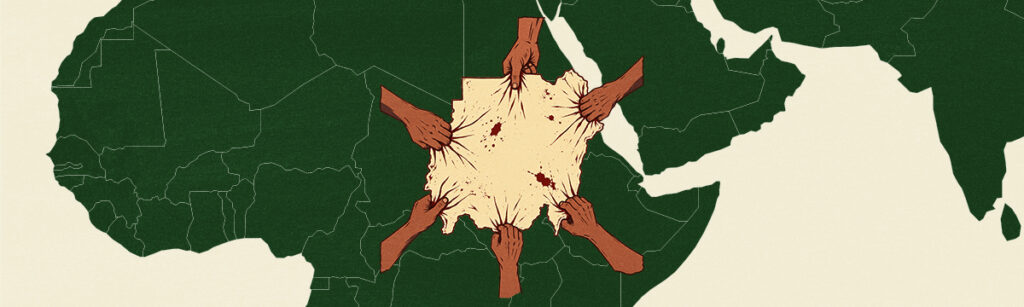
This intricate map of alliances illustrates how national sovereignty has eroded, shifting decision-making to the international arena. Countries influence their allies in Sudan to advance their interests amid internal fragility and disintegration. These developments heighten concerns that Sudan will become a battleground for regional and international conflict, prolonging the devastating war and postponing the restoration of sovereignty for a country that once proclaimed the “Three No’s” to determine its own political destiny.
However, this ambiguous reality is the culmination of decades of inaction and failure to resolve mounting national crises. Sudan’s fragile situation meant that a major explosion was inevitable, one that would either force a radical solution, paving the way for a cohesive state, or drive everyone into senseless infighting. This would result in several fragmented mini-states bound together geographically, but torn apart by a shattered sense of national identity.